Required Reading
This week: the Louvre reopens the room where it happens, a Texas artist’s outdoor collection, Nancy Drew in the public domain, Rachel Cusk and Natalie Portman have beef, and more.

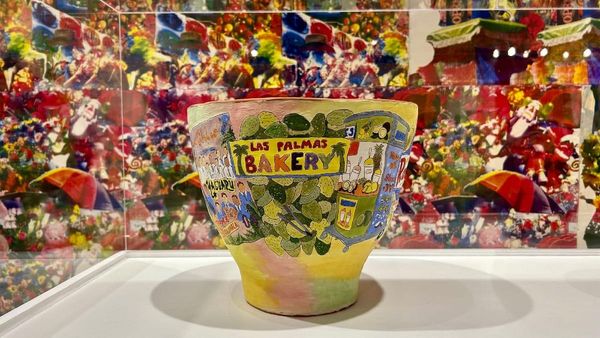
Michael Agresta reports for Texas Monthly on the curious "wonderland" of 75-year-old artist John Dilandro, whose massive front-yard collection has become a treasure box of creativity despite its dismissal as "folk art":
It’s hard to imagine a more authentic encounter with homemade, self-taught, personal, and profit-eschewing creative expression—“folk art” or “outsider art,” as the art world likes to classify it—than a visit to Dilandro’s farm. During my drop-in, I did not meet with any venomous snakes, but I did contend with mud, merciless late-afternoon mosquitoes, and armies of enormous red ants, whom Dilandro allows to carve busy paths through the grass among his artworks. Out of necessity, I’d shown up unannounced. Dilandro has no website, email, or listed phone number.
Friendly and still nimble on his feet, Dilandro shows his age mostly through a wheezy voice, his country accent still audible through a sonorous whisper. He says he was not exposed to art while growing up as a farm kid in the 1950s and ’60s and never paid attention to artistic goings-on at Texas State in the 23 years he worked there. When I ask if his mother, a homemaker, filled the house with bric-a-brac like the stuff that decorates his gate and lawn, he laughs. “No. We were poor.”
Moira Donegan reflects on a new book about the life and work of artist and activist Celeste Dupuy-Spencer, who tragically passed away earlier this year. For Bookforum, Donegan writes:
Part biography of Dupuy-Spencer, part meditation on her work, and part guide to the painter’s oeuvre, Burning in the Eyes of the Maker traces Dupuy-Spencer’s evolving relationship to politics and myth. It is a deeply felt collaboration between MacLaughlin and the painter, with pieces sometimes narrated by the figures on the canvases, exploring the narratives they find themselves in, and sometimes told from MacLaughlin’s point of view, recounting her experience confronting the works. By design, MacLaughlin’s writing is more of an encounter with the paintings than a statement about them. Her great virtue as a writer is a clear-eyed moral realism, a willingness to see her own complicity in the histories of violence and systems of exploitation that Dupuy-Spencer’s work depicts—a challenge inherent in the paintings for which not all viewers are prepared. MacLaughlin and Dupuy-Spencer alike seem alert to the burdens of this kind of knowledge: many people, after all, respond to this analysis of American life by trying to excuse their own role in it. “The great theme of her work,” MacLaughlin writes of the painter, “is denial.”
Colombian novelist Ingrid Rojas Contreras writes movingly in Time about her father, whom she recognizes in 26-year-old Joan Sebastián Guerrero and other fathers who have been killed by ICE this year:
My family of four lived in Colombia amidst the uncertainty and fear in the 90s. My father was kidnapped by FARC, the violent Fuerzas Armadas Revolucionarias de Colombia. He was let go in the end. We continued to receive threatening calls to our home. In 1998, we left Bogotá. Since that time, we have dreamt of finding a place to live together in peace. We hoped it would be in the United States.
Now, I often think about the irony of us escaping Colombia only to be seized by the fear of detention in America.
In April, my dad returned to the U.S. He was nervous at the airport once again, not knowing what would happen to him. Increasingly in my family, we ask the question of where we will live. It seems altogether out of the question that we will all live together in the United States.
Jia Tolentino, whose 2019 "Instagram face" essay gave language to a new era of beauty standards, is back in the New Yorker to investigate plastic surgery's impact on desirability and self-image:
The vibe, over all, is a kind of internet-invented nonsexuality: putative straightness is only the pretext for various broadcast demonstrations of dominance and submission, in perpetual psychological reference to other putatively straight men. Women are called “foids” in the looksmax lexicon, short for “female humanoids,” and they are sliced and diced, worshipped and denigrated, in the same coldly unfeeling way. One popular post on looksmax.org lists four versions of the “Top 30 Most Beautiful & Attractive Girls On the Planet (Combined Golden Ratio + Sexual Dimorphism & Appeal + Side Profile).” The post displays a bunch of famous models with Instagram Face; an author’s note clarifies that the lists only contain white women and “mixed-race women who are sufficiently white-passing.” It is important, to looksmaxxers, that these women seem to be naturally beautiful: the post imperiously rules out the many Instagram girls who have obviously altered their appearance. The community has invented a way to admire men for beauty work and to hate women for the same.
Author Ellen O’Connell Whittet ponders the fate of the Nancy Drew and Miss Marple books for the Los Angeles Review of Books, considering their evolving role now that they have entered into the public domain:
This year, the first four Nancy Drew books and the first Miss Marple novel entered the US public domain. The cultural response has been overwhelmingly celebratory: there’s a Christie Netflix adaptation, a Christie British Library exhibition, and a forthcoming novel about grown-up Nancy Drew. The implicit message is that these two women detectives, born around the same time (Miss Marple first appeared in a short story in 1927), are finally free. But the word “free” seems wrong because it hints at someone keeping them either safe or hostage, and it glosses over what crime was committed and whose freedom we’re actually talking about.
For JSTOR Daily, April White digs into the archives of Johnetta Brazzell, who recorded firsthand stories of the Great Migration — some of which you can listen to in the article:
Brazzell and several of her colleagues in the Urban Affairs Center at Oakland University, located just outside the Pontiac city limits, were part of a new movement of oral historians documenting the stories of everyday people in their own voices with the use of newly portable and increasingly affordable cassette recorders. “We’re trying to locate people who lived [in Pontiac] and get eyewitness accounts of what was going on, how people lived, where they worked and, generally, just what life was like for them,” she told the Detroit Free Press in 1975. There was an urgency to her efforts. “If we don’t get it from those individuals, then we can’t get it from anyone else. Oral history is usually considered a supplement to written history, but here oral history is the only account anyone has.”
Frontline's Martin Smith conducted an excellent interview with Saudi exile Saad Aljabri about Trump's relationship with the nation:
Artist Adrianne Wortzel, who has strabismus and cannot see in three dimensions, explains how she renders depth and perception in her paintings:
@hellotohera This exquisite artist can only see in 2D - and uses it to turn her work into an optical delight ♥️ Adrianne Wortzel’s solo show at JDJ Gallery is on view until then end of this month and we highly recommend a visit! #thingstodonyc #nyc #supportartists ♬ original sound - Hera
Rachel Cusk is apparently writing a book based in part on Natalie Portman, who seems to be less than thrilled with the portrayal — I'm sat:
@georgiejxmes from “a novelist’s dark portrait of natalie portman” by valerie stivers at unherd us #natalieportman #moviestar #leontheprofessional #literary #rachelcusk ♬ Musical Violino - Marcos Abreu
The price we pay for a hot girl summer …
@aiden_london It was actually a 2 day trop
♬ som original - memeSpotn
Required Reading is published every Thursday afternoon and comprises a short list of art-related links to long-form articles, videos, blog posts, or photo essays worth a second look.