Sanford Wurmfeld’s Unstable Geometry
He emphasizes the temporality of looking, as well as underscores that one’s experience of time is subjective.

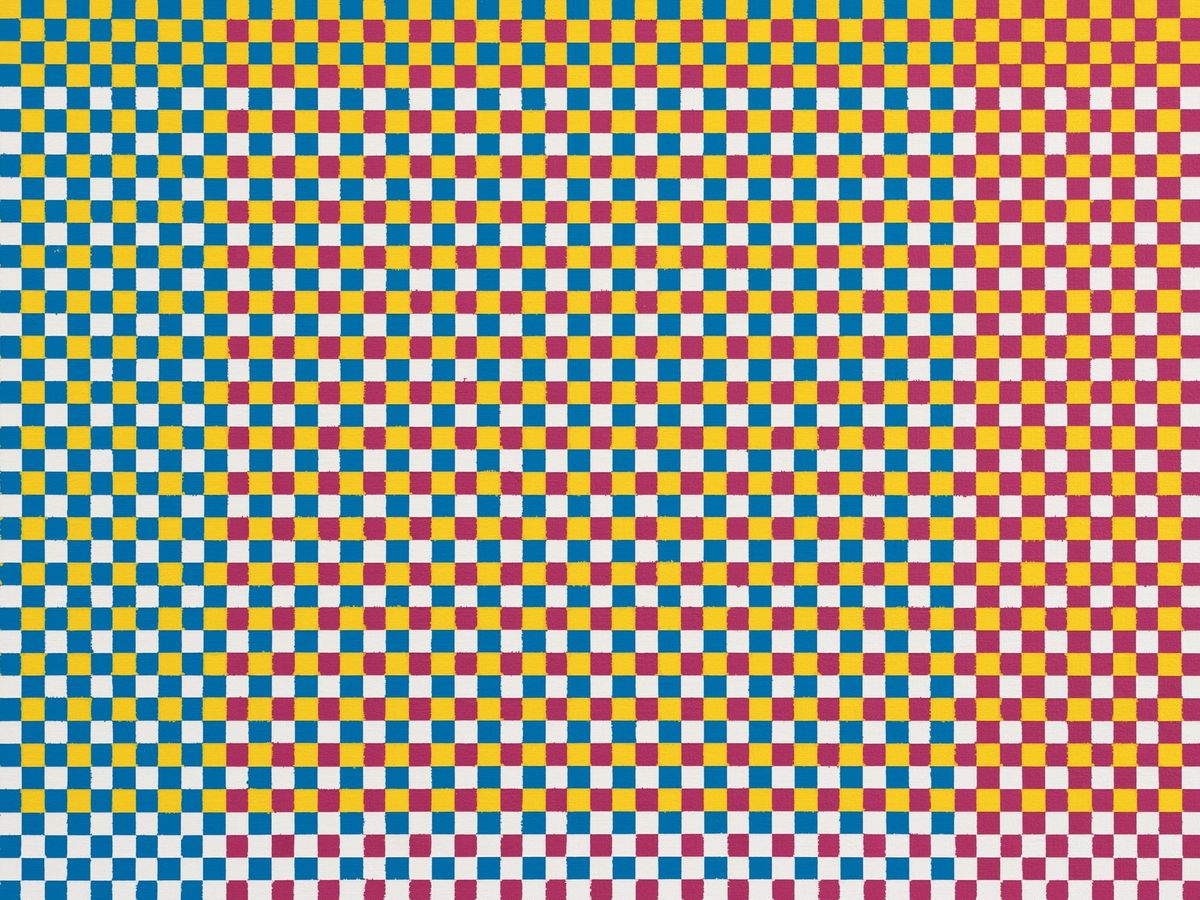
From the beginning of his career, Sanford Wurmfeld has understood that looking is a temporal act, and has never stopped exploring the implications of that idea. In 1968, he was the youngest artist included in the important Museum of Modern Art exhibition, Art of the Real, curated by Eugene C. Goossen. His contribution consisted of painted hexagonal columns that viewers were required to circumnavigate in order to get the full, continuously changing visual experience, while only being able to see part of it at a time. In 1971, inspired by Ad Reinhardt, whose late paintings were included in Goossen’s exhibition, Wurmfeld divided a square surface into nine symmetrical squares, which he further divided into one-inch squares. Using this format of a grid set within a larger one, and limiting his palette to four hues, all of which would cover a predetermined area of the painting and meet in the center, he investigated the optical interactions of color.
Having written about Wurmfeld previously, I was curious to learn more about his trajectory, which has long flown under the radar of the New York art world. Done between 1971 and ’74, the six paintings and one study in his exhibition, Squares 1971–74, at Ceysson & Bénétière gave me a fuller picture of Wurmfeld’s methodical and relentless investigation into color, as well as what distinguishes his work from other artists working in this area. In contrast to Bridget Riley, Julian Stanczak, and Richard Anuskiewicz, Wurmfeld never limited himself to black and white, nor became illusionistic.