Squeak Carnwath Paints Her Own Path
This artist rejects the notion that paint as a medium inevitably becomes exhausted, incapable of making something, however broken it may be.

When I interviewed Squeak Carnwath in 2006, she told me that painting “can take on any form.” Her desire to make “something expansive” within the legacy of painting has interested me because it rejects the notion that the medium inevitably becomes exhausted, incapable of making something, however broken it may be. It is why I went to her latest exhibition, Goddess of All, at Jane Lombard.
Carwath, whose work was the subject of an in-depth examination, Painting Is No Ordinary Object, organized by Karen Tsujimoto at the Oakland Museum of California in 2009, has long flown under the radar in New York City. Neither the Whitney Museum of American Art nor the Museum of Modern Art has anything in their collection by Carnwath, now in her late 70s.
I cannot help but wonder if this neglect is because of her belief in the legacy of oil painting dating back to the Renaissance, as well as the fact that she has never been associated with Bay Area figurative painting or the Funk movement, despite living, teaching, and exhibiting there for many years. Artists who follow their own paths are generally not held in high regard unless it fits a curator’s agenda regarding politics, hot-button topics, or the “right” kind of abstraction — which are reasons why Joanne Greenbaum, a New York-based painter who is Carnwath’s temperamental opposite, is missing from those museum collections, too. Their fierce independence has not gained them the recognition it should have long ago.
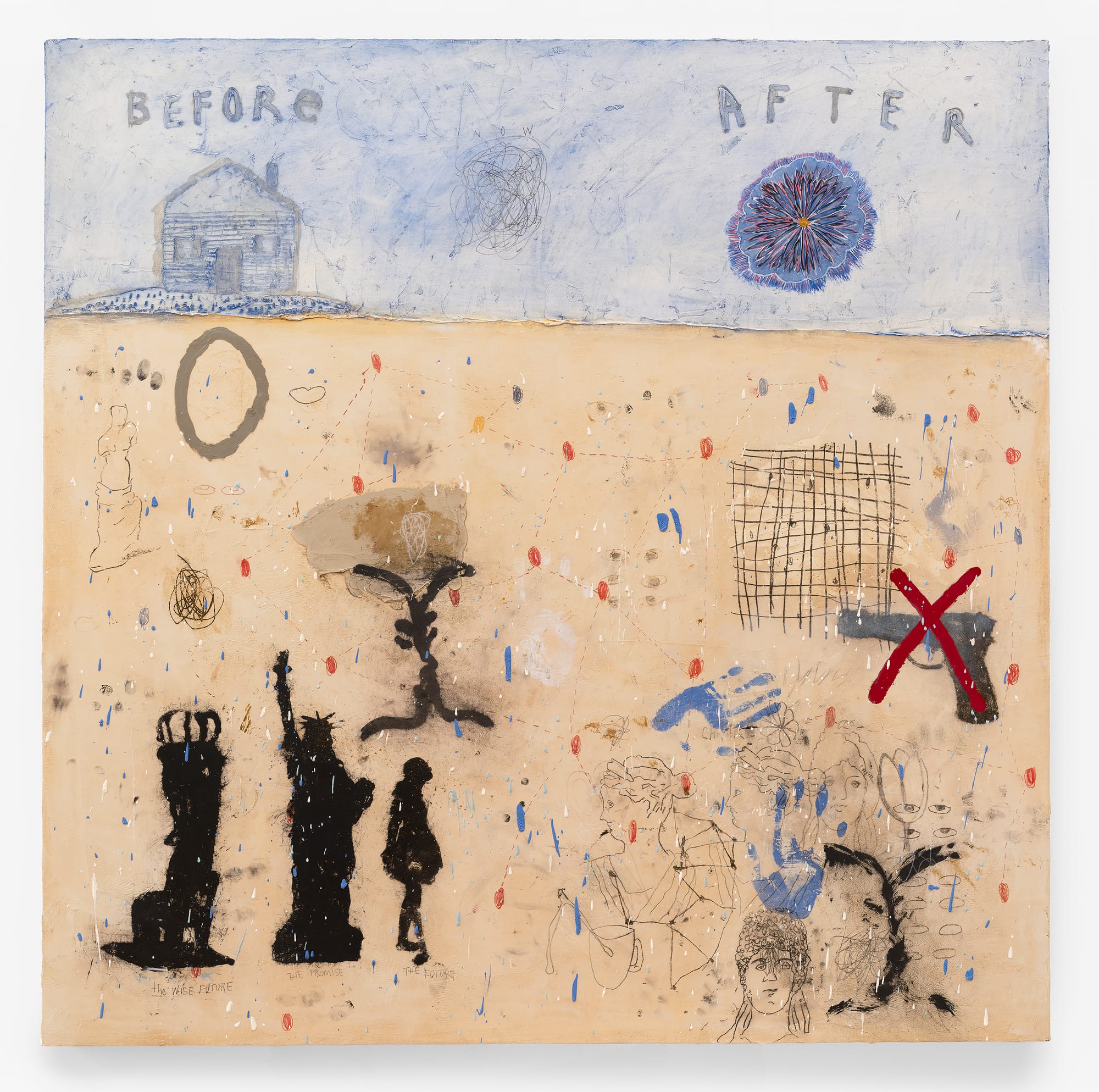
There are 11 paintings in the exhibition, all of them square and ranging from 36 by 36 inches to 77 by 77 inches. Done in oil and alkyd on canvas mounted on panel with the titles written on the sides, they are made completely in oil paint, even when the lines and words appear to be drawn in pencil.
Carnwath’s continually expanding vocabulary consists of meaningful motifs that reappear in her work — an LP record with a red label, a sinking ship, a 45 automatic with a red “X” through it, the outlines of the Venus de Milo and other classical busts and statuary, a tree stump, bands of color and abstract patterns — along with different phrases, such as “guilt free zone.” The LP record signifies that we go around once in life, while the sinking ship conveys inescapable disaster.
Goddess of All includes her recent addition of a motif consisting of three black silhouettes: Edgar Degas’s “The Little Fourteen-Year-Old Dancer” (c. 1881), the Statue of Liberty, and what looks like a crowned figure sitting in a high-backed chair or throne. Each silhouette signifies an idealized view of a woman, from aspiring dancer to powerful ruler.
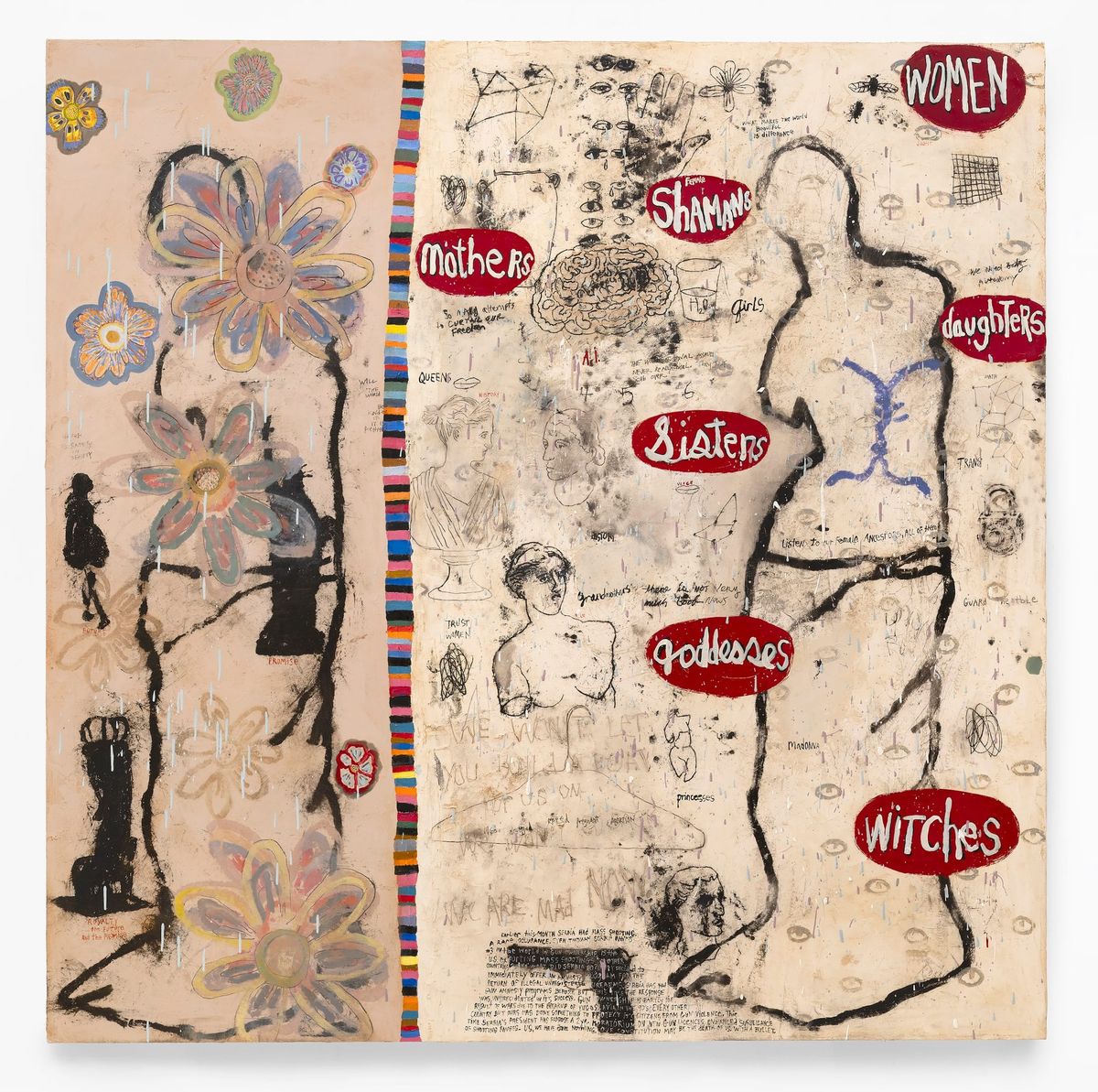
“Ancestors and Future Ghosts” (2023) is divided vertically into two unequal areas (one-third on the left and two-thirds on the right) by a band consisting of different-colored rectangles stacked on top of each other. On the left side, on a ground the color of poached salmon, we see the three silhouettes, writing, the black outline of an unidentified female figure overlaid by large, many-petaled flowers. From the petals to the writing, everything underscores the painting’s flat surface as a repository for graffiti, images, image fragments, and overheard snippets of the langue de tribe. Carnwath’s paintings comment on the present even as they speak to ancestors and speculate about future ghosts.
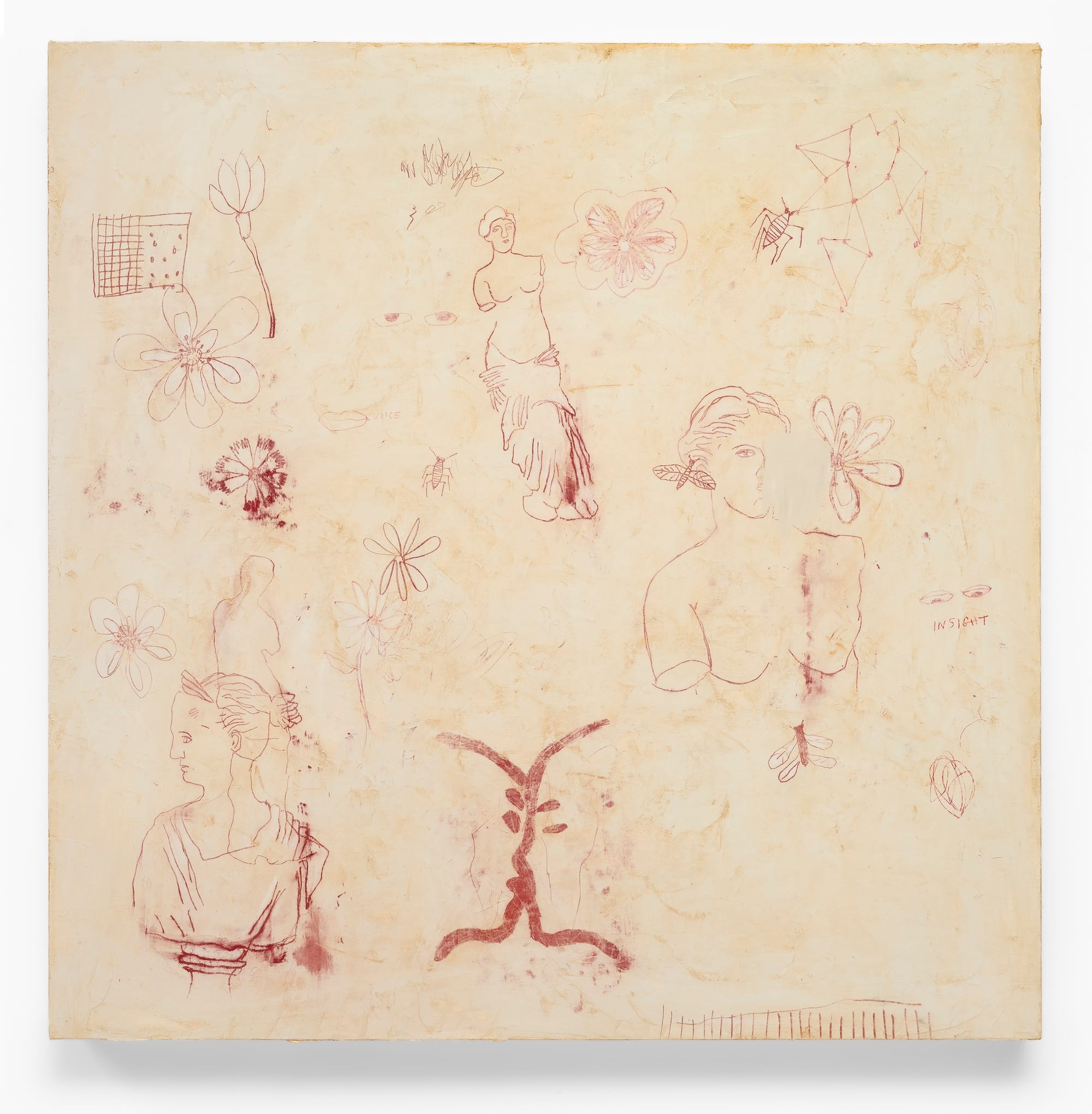
“Ancient Fragments” (2025) is populated by red outlines of Roman busts, goddesses, insects, flowers, and the motif of two genderless faces passionately kissing. Two disembodied eyes look down at the word “insight.”
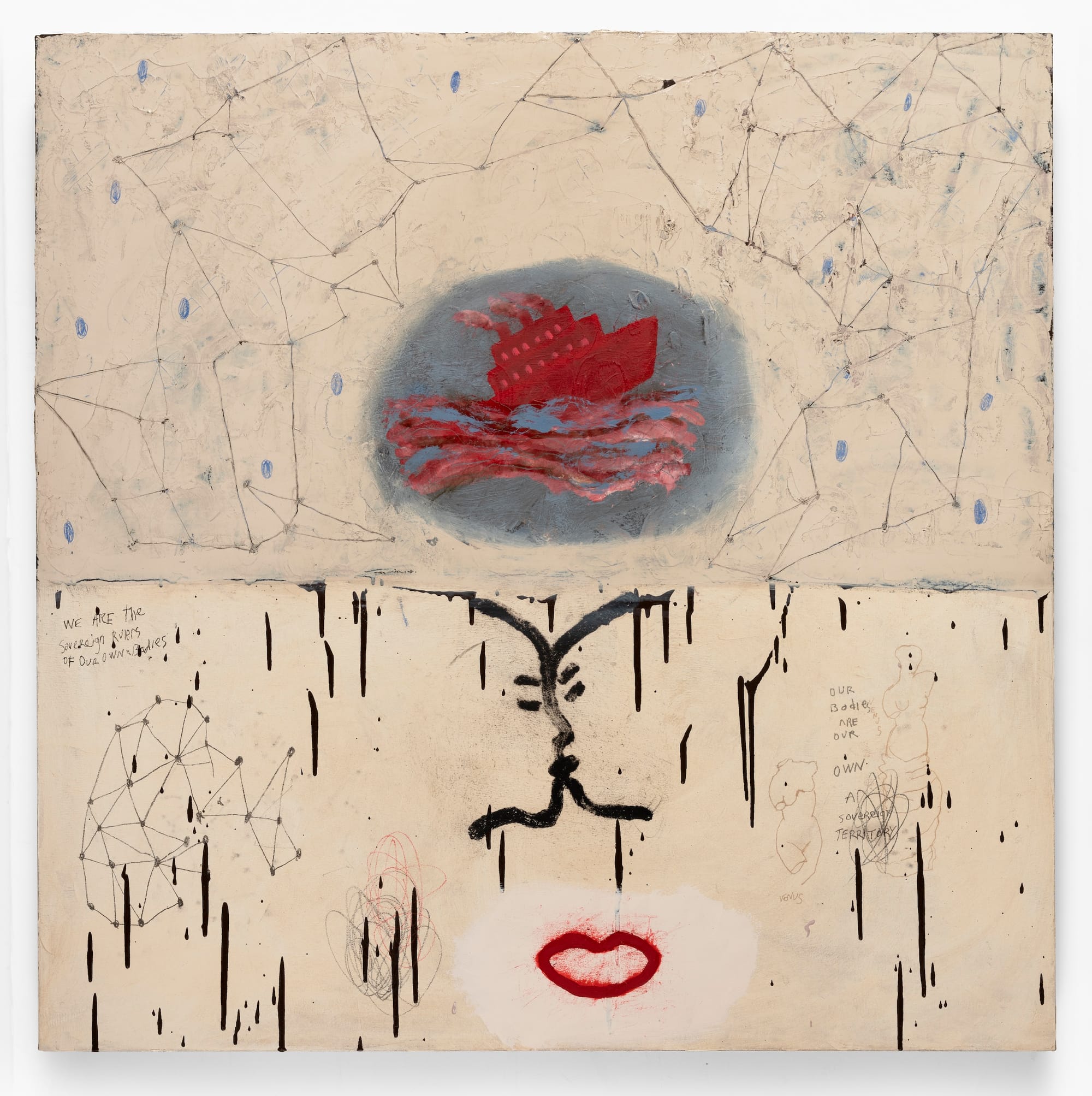
What are we to make of this or the other paintings in the exhibition? I don’t see Carnwath as being didactic when she writes “Our bodies are our own” above the scribbled-over phrase “a sovereign territory” on the lower right side of “Our Own” (2022). Opposite this statement, on the left side of the painting, we read, “We are the sovereign rulers of our own bodies.”
Carnwath has recognized that the world she grew up in has changed and there is no going back. The sinking ship in the upper half of the painting, against a pale gray ground, is situated above the black outline of two faces kissing against an off-white ground, above the crude lineation of crimson lips. Carnwath operates under the deep paradox of her commitment to paint and painting, even as she lives in a world that is spiraling out of control, and wrests out of it precarious instances of order.
Goddess of All continues at Jane Lombard Gallery (58 White Street, Tribeca, Manhattan) through February 28. The exhibition was organized by the gallery.