The Angel of History Is Stuck in Jerusalem
The iconic Paul Klee work is missing from an exhibition about fascism at the Jewish Museum in New York due to "current conditions" in Israel.

Editor's Note: The following story contains mentions of self-harm. If you or someone you know is struggling, call or text 988 or visit 988lifeline.org to reach the Suicide & Crisis Lifeline.
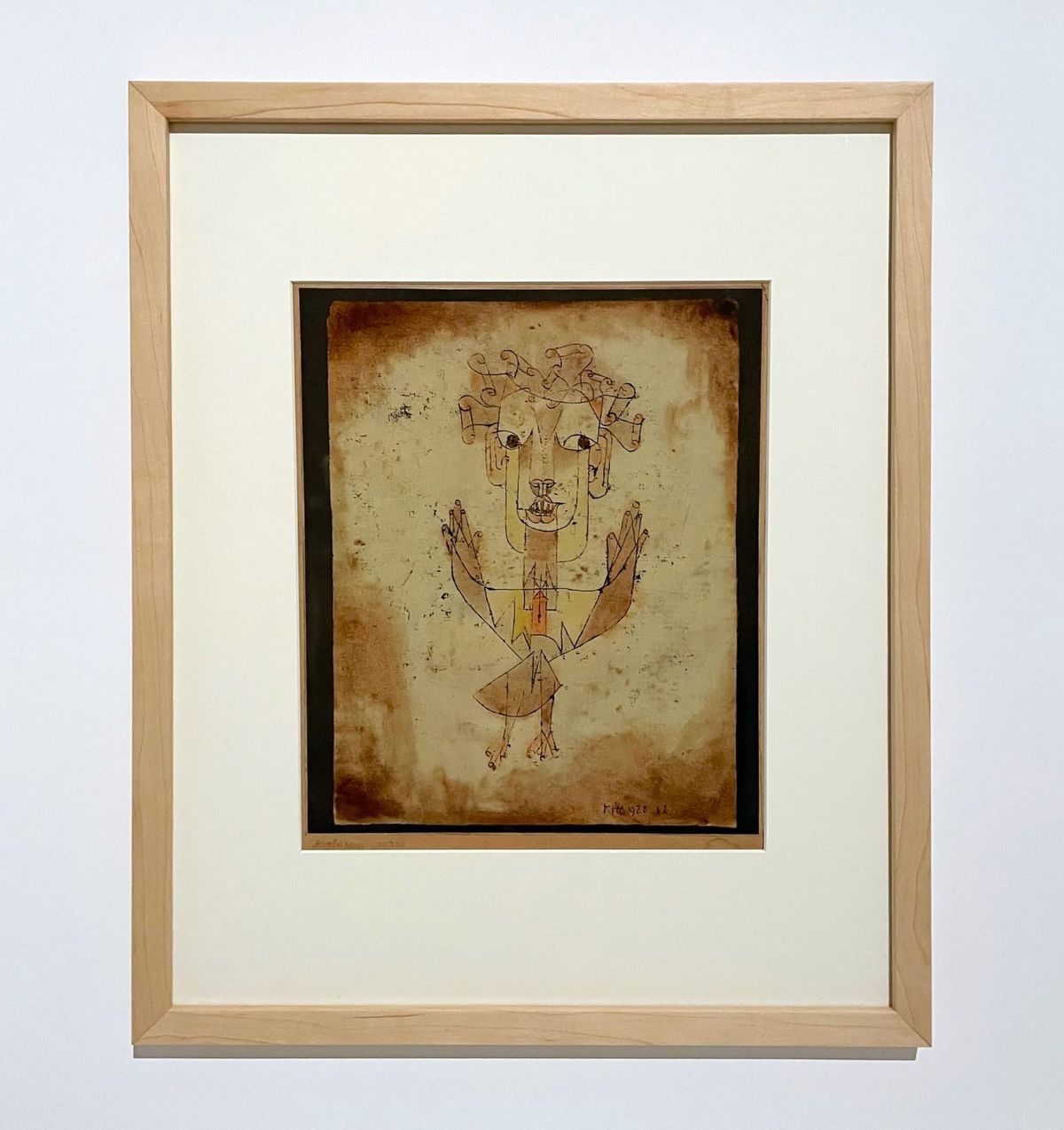
The most famous work in Paul Klee: Other Possible Worlds at the Jewish Museum is defined not by its creator, but by its owner. “Angelus Novus” (1920) is etched into 20th-century history as a source of inspiration for cultural critic Walter Benjamin, who bought it in 1921, and as a symbol of his persecution by the Nazis and subsequent suicide.
The political thrust of Klee’s art, together with his search for artistic freedom in the 1930s, the last decade of his life, forms the exhibition’s theme. It opens with several works that predate 1930, some as early as 1903. Ostensibly intended to both prefigure the politics of Klee’s later art and illustrate its aesthetic contrast, the strategy feels at times like an excuse to include crowd-pleasing pieces from the 1910s and ’20s, defined by delicate linework and stained-glass color.
No work gets more fanfare than “Angelus Novus.” The watercolor of a comically awkward angel with an oversized head and undersized wings gets its own gallery space. (Or, more accurately, a reproduction that acts as a placeholder until the original arrives from its home in Jerusalem’s Israel Museum, delayed vaguely by “current conditions affecting international transport,” as the wall text puts it.) On an adjacent wall is a passage about the figure as the “Angel of History” from Benjamin’s “Theses on the Philosophy of History” (1940) that reads in part:
His face is turned toward the past. Where we perceive a chain of events, he sees one single catastrophe that keeps piling wreckage upon wreckage and hurls it in front of his feet .… The storm irresistibly propels him into the future to which his back is turned, while the pile of debris before him grows skyward. This storm is what we call progress.
The rare chance to see “Angelus Novus” in person is reason enough to visit (assuming it eventually reaches New York City). Yet the work and Benjamin’s text play an outsize role here, in effect positioning a 1920 image and its 1940 interpretation by a German-Jewish philosopher as the fulcrum of a show dedicated to Klee’s 1930s output.
Both Klee and Benjamin were targeted by the Nazis during World War II, but their lives and war experiences were distinct. Klee was not Jewish, but he was disparaged as a “Galician Jew” by the Nazis. When the Nazis smeared his name in Germany, he fled to his birthplace of Switzerland, now in exile, as artists like George Grosz and Max Beckmann fled to the United States.
Benjamin’s situation was more precarious: After years of exile in various European countries, he committed suicide in Spain in 1940 rather than face deportation. His meditations on European history and progress are related to Klee’s subtle critiques of authoritarianism, but the two are not intertwined. While Benjamin viewed “Angelus Novus” as a conflicted view of progress — and a harbinger of the calamity to come — different interpretations of Klee’s intended meaning float around art historical texts. For instance, Annie Bourneuf’s 2022 book Behind the Angel of History: The Angelus Novus and Its Interleaf posits a connection with Matthias Grünewald’s 1512–16 “Isenheim Altarpiece,” based on the discovery of a 19th-century engraving of Martin Luther behind Klee’s work and a formal similarity to Grünewald’s angels.
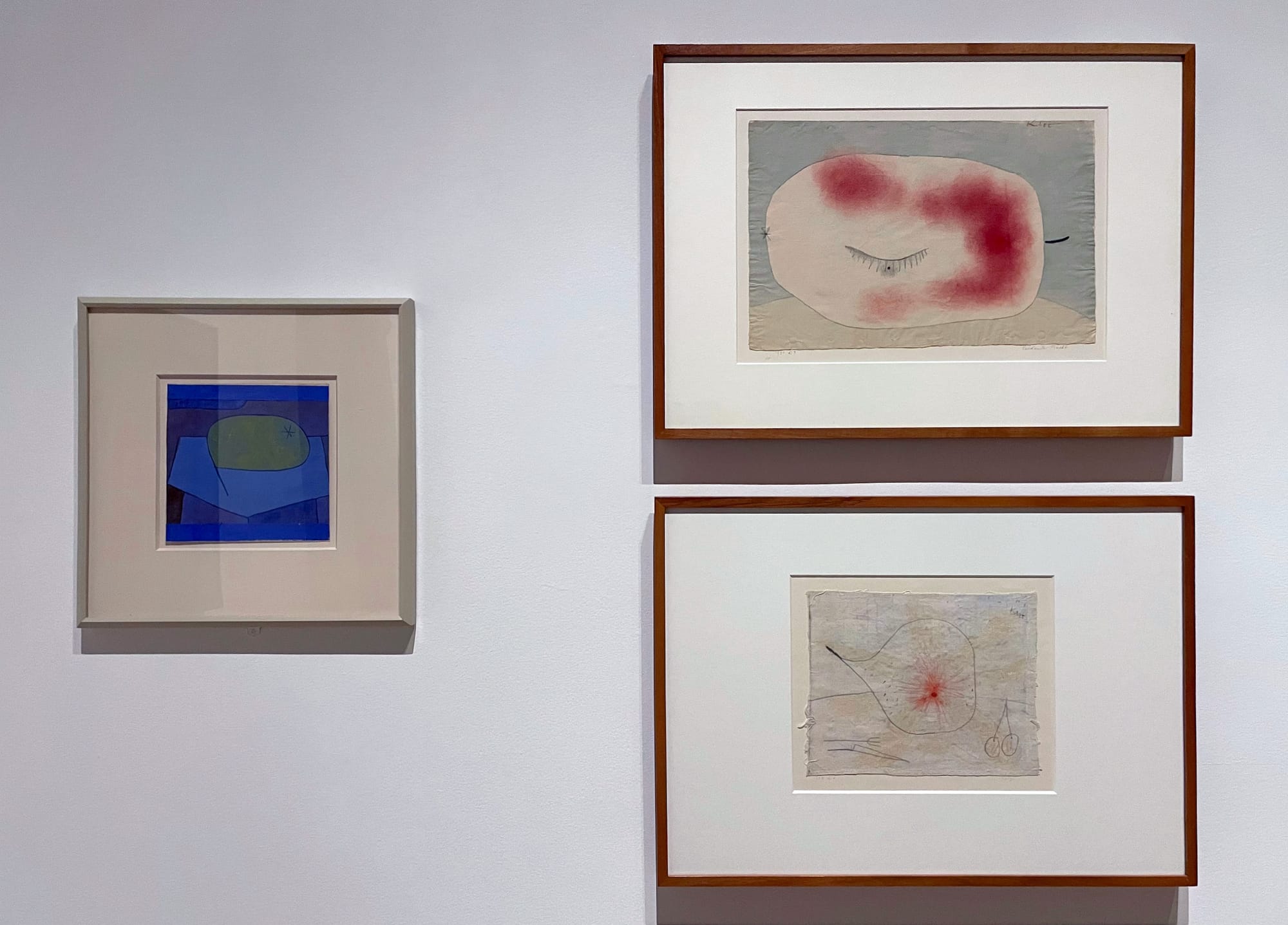
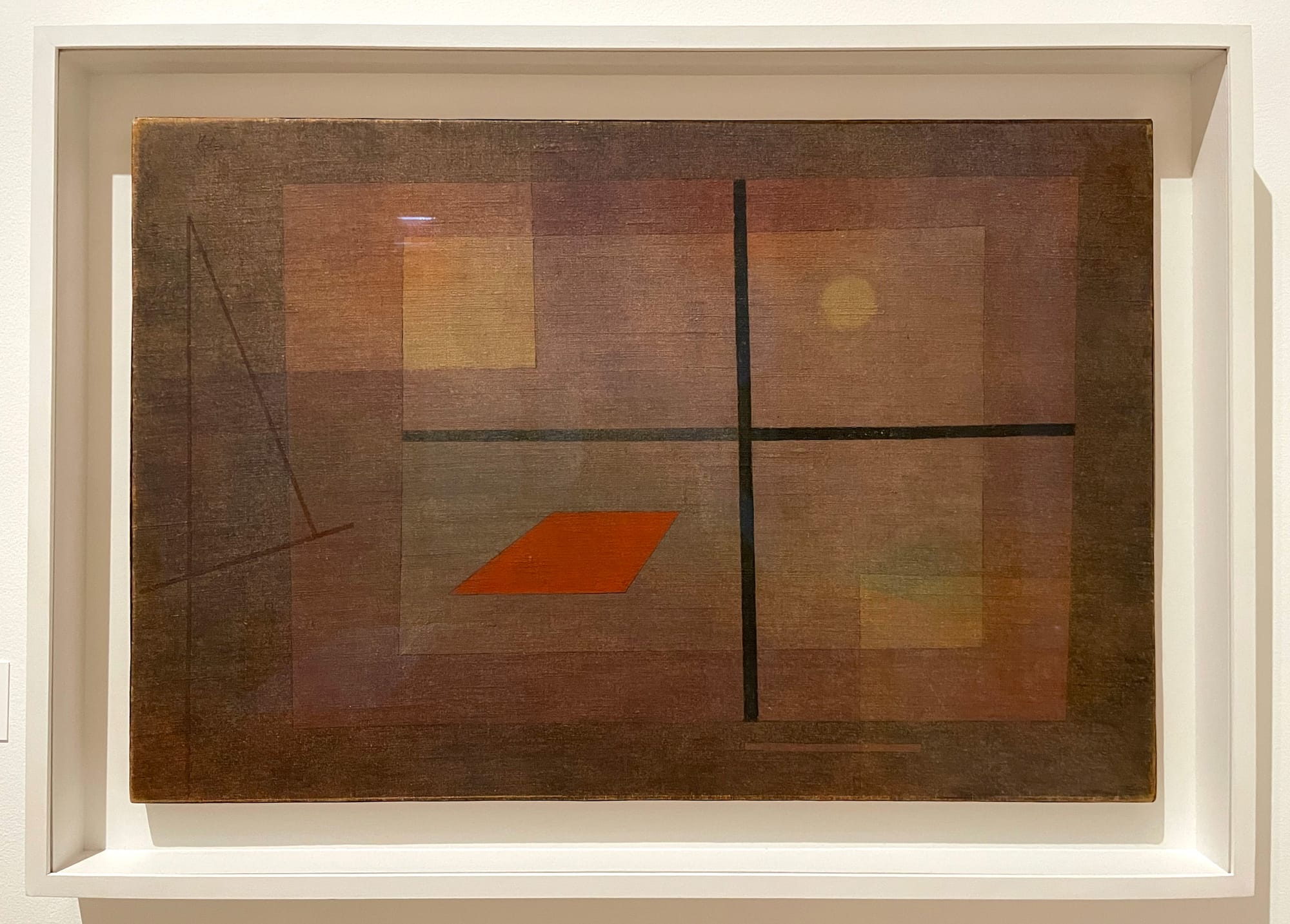
Once the show reaches Klee’s last decade, several pieces do allude to Germany’s descent into a fascist state. Some do so elliptically, such as the mixed-media watercolor “Suffering Fruit” (1934), depicting a pale, oblong shape with a closed eye and red patches, suggesting both a figure covered with rashes or a ripe pear. Others are more direct, as in “Struck from the List” (1933), a face partitioned into color blocks, referring to Klee’s dismissal from his teaching post by the Nazis. But just as many come across as ambiguous or allegorical — for instance, the linear “Lonely Flower” (1934), awash in translucent color, the foreboding “Forest Witches” (1938), its thick black lines suggesting hidden figures, and “But the Red Roof!” (1935), a softly luminous view through a window, rendered in thin earth tones and punctuated by a blazing orange-red parallelogram.
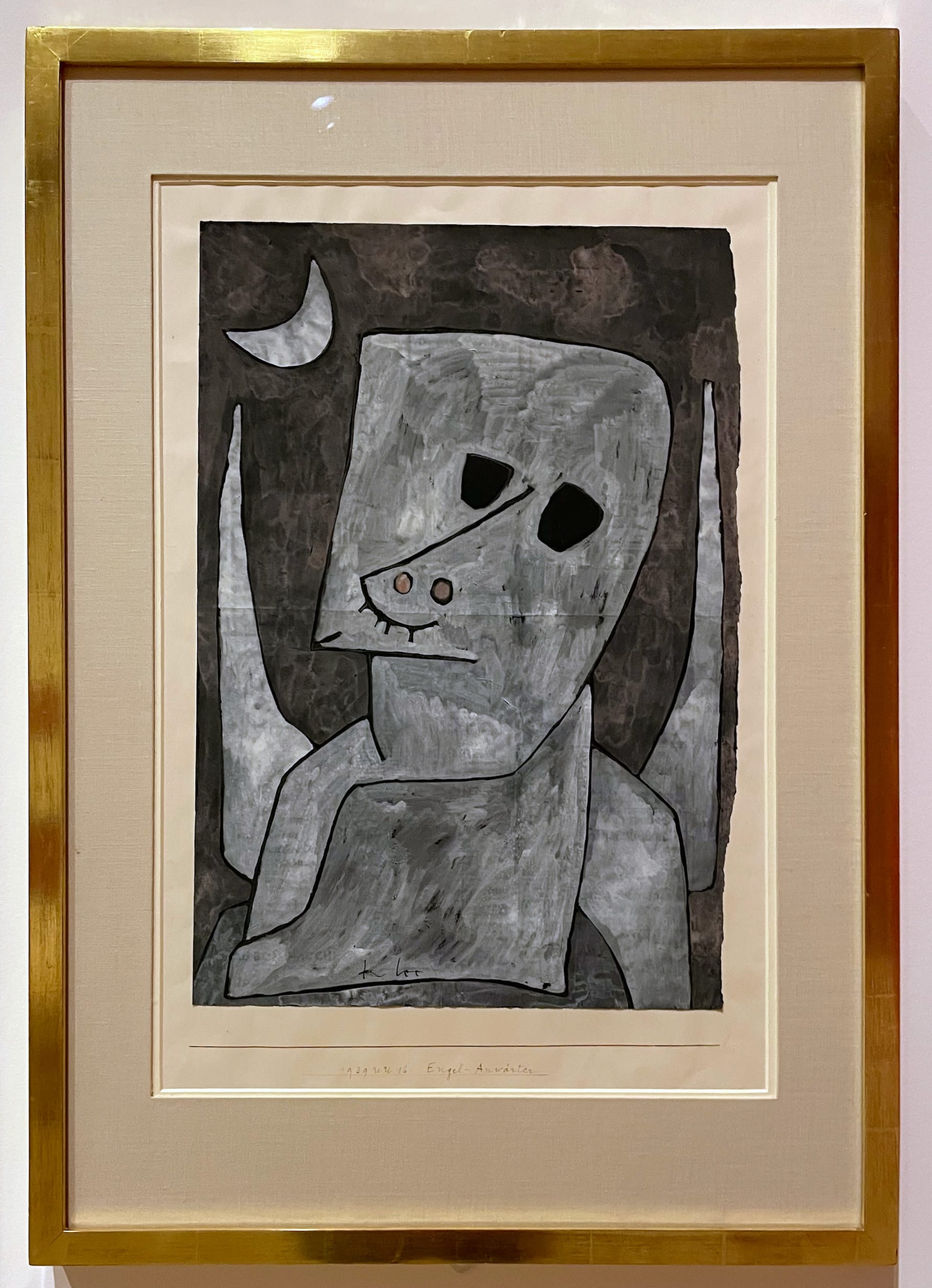
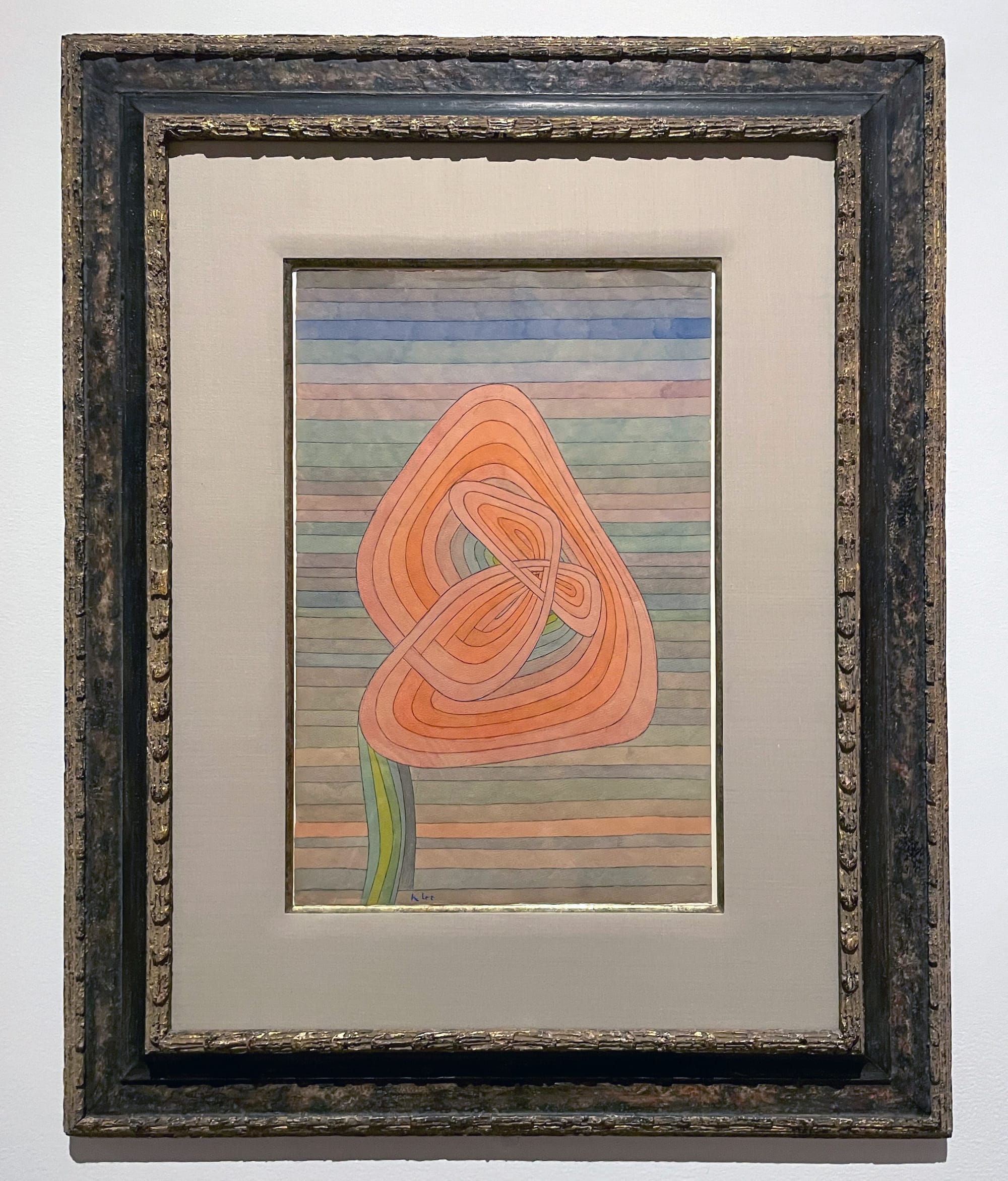
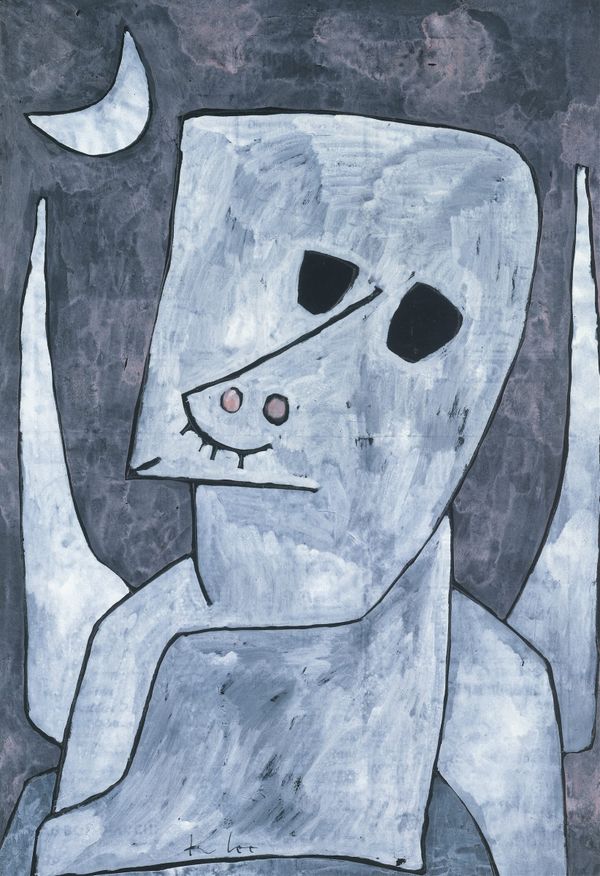
Left: Paul Klee, “Lonely Flower” (einsame Blüte) (1934), watercolor with pen and black ink on tan paper, laid down; right: Paul Klee, “Angel Applicant” (Engel-Anwärter) (1939), opaque watercolor, brush and black ink, and graphite on paper mounted on board
It’s not that these works have no sociopolitical conscience or can’t be read as a direct critique of fascism. But at times, Klee's perspective seems like it's read too closely in line with Benjamin’s text to support the show's premise that the former “confronted the harsh terrain of fascism.”
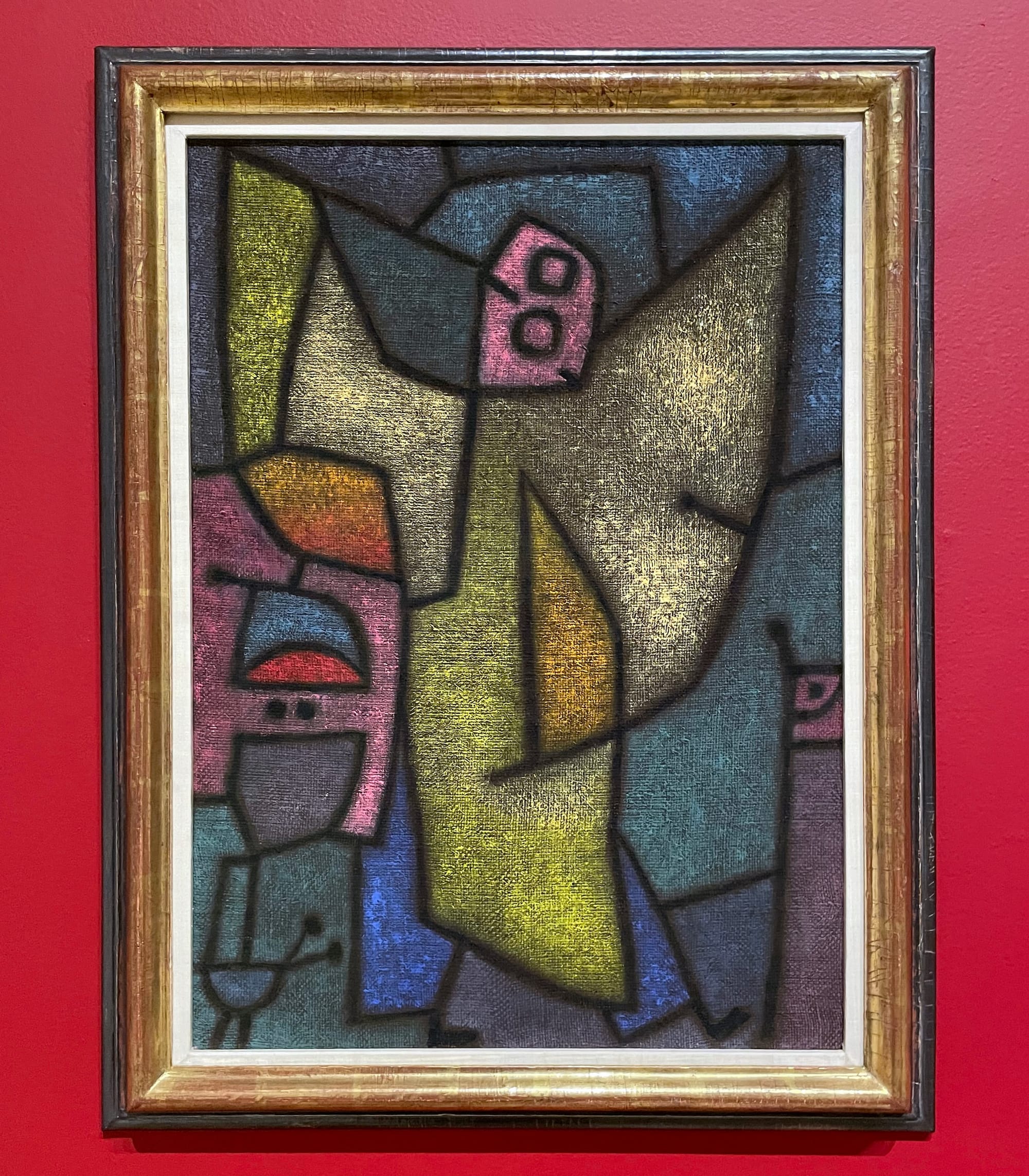
The wall text accompanying two “angel” pictures from 1939 reads, “In his angel cycle Klee confronts the hateful, annihilating Nazi regime, often with a strong spark of humor, as in Angel, Still Female, speaking to those who feel unfulfilled, or not having quite arrived in Angel Applicant.” I can see Klee’s angels mourning the triumph of war and fascism in 1939 and judging the fate of its perpetrators, but mortality and humanity are in there too — particularly in the quasi-cubist creature of “Angel Applicant,” painted in elephant-gray and resembling an animal striving to see with its solid black eyes. “Many of Klee’s angels are still largely human,” art historian Gert Schiff wrote in a 1987 essay on the subject, including those still transforming or in the “application” stage. Made a year before his death, while he was in physical pain and terminally ill with scleroderma, the images wander into existential territory as they close in on the artist’s own mortality.
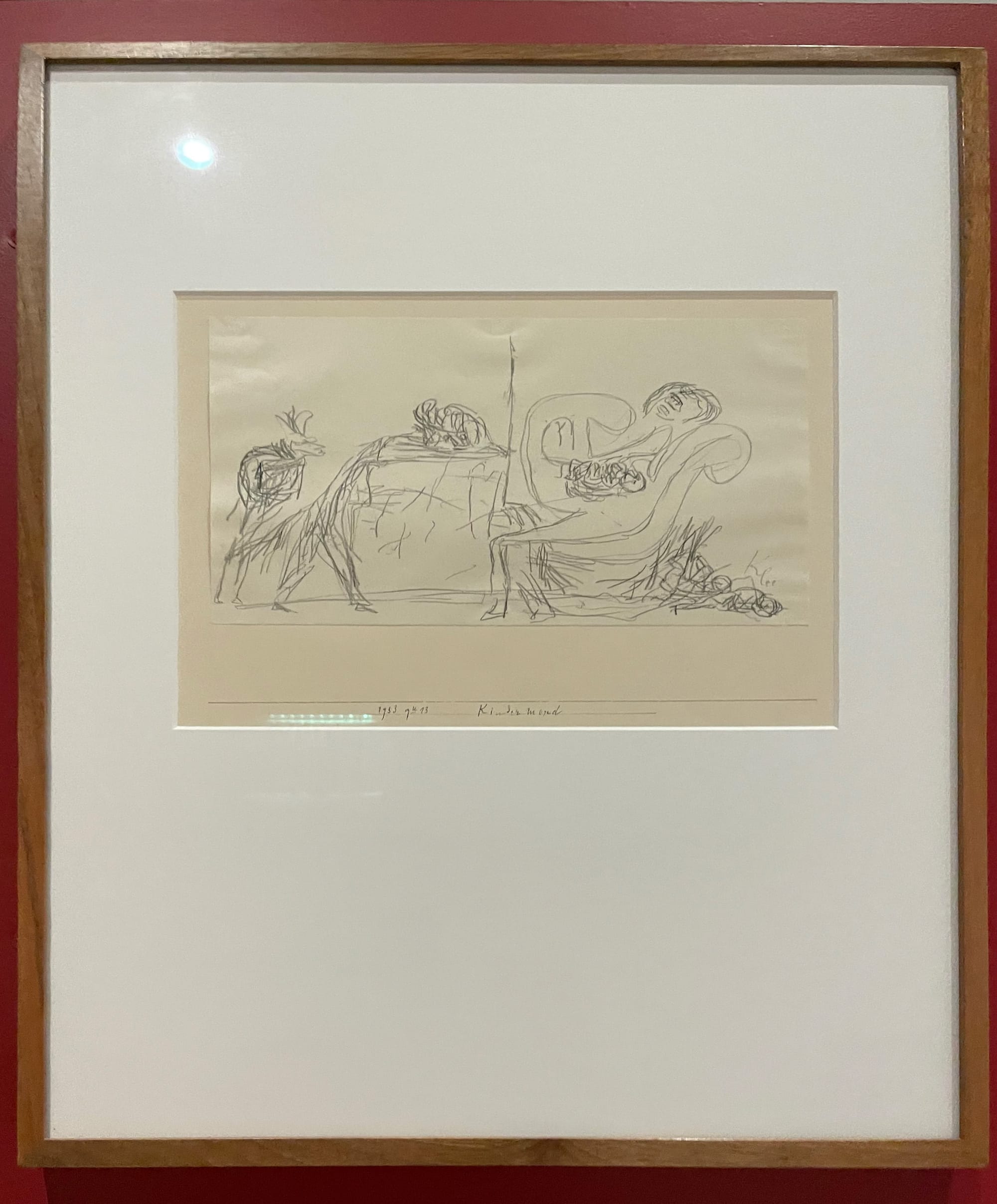
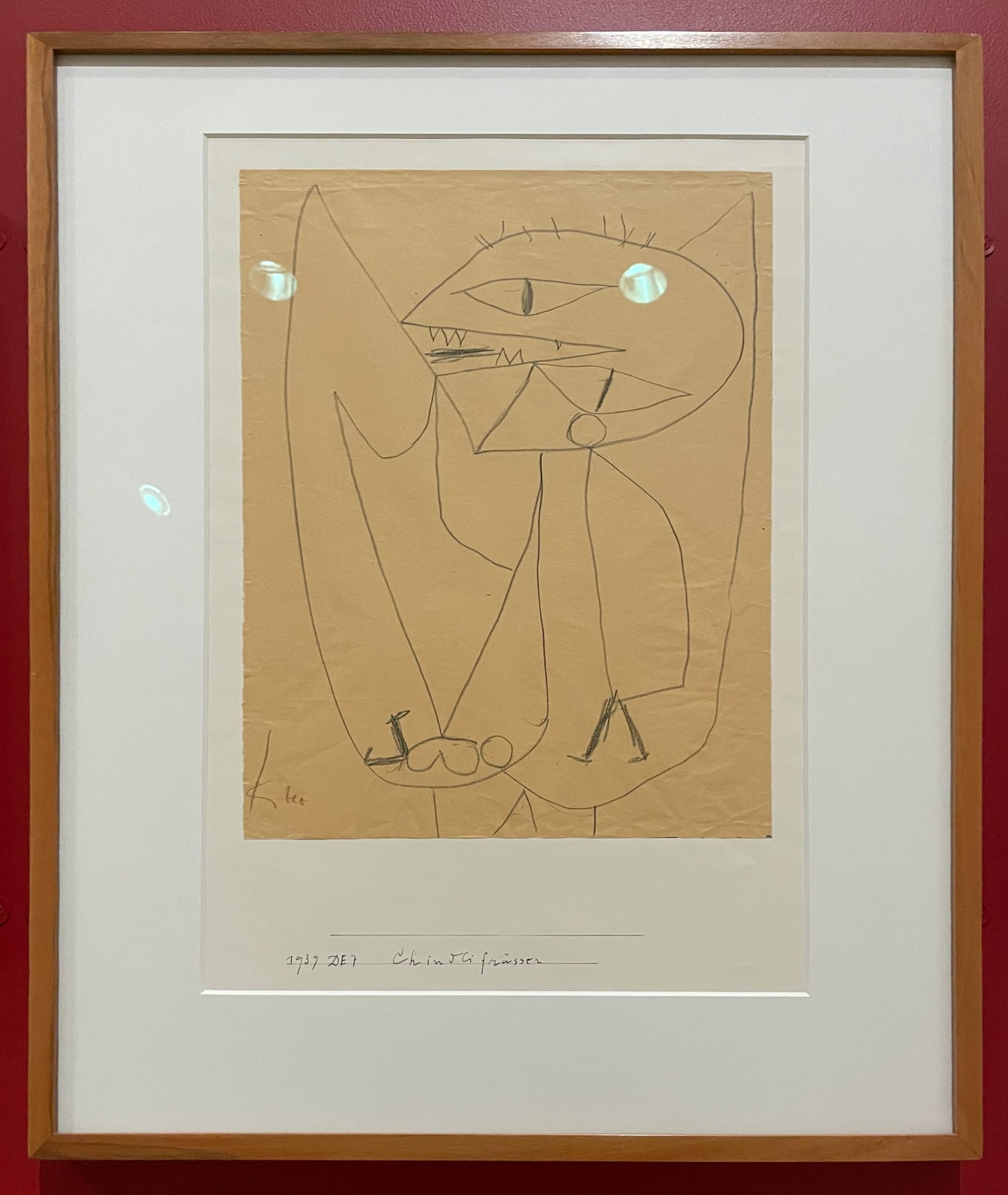
Left: Paul Klee, “Child Murder” (Kindermord) (1933), chalk on paper on cardboard; right: Paul Klee, “Child-Eater” (Chindlifrässer) (1939), chalk and red chalk on paper on cardboard
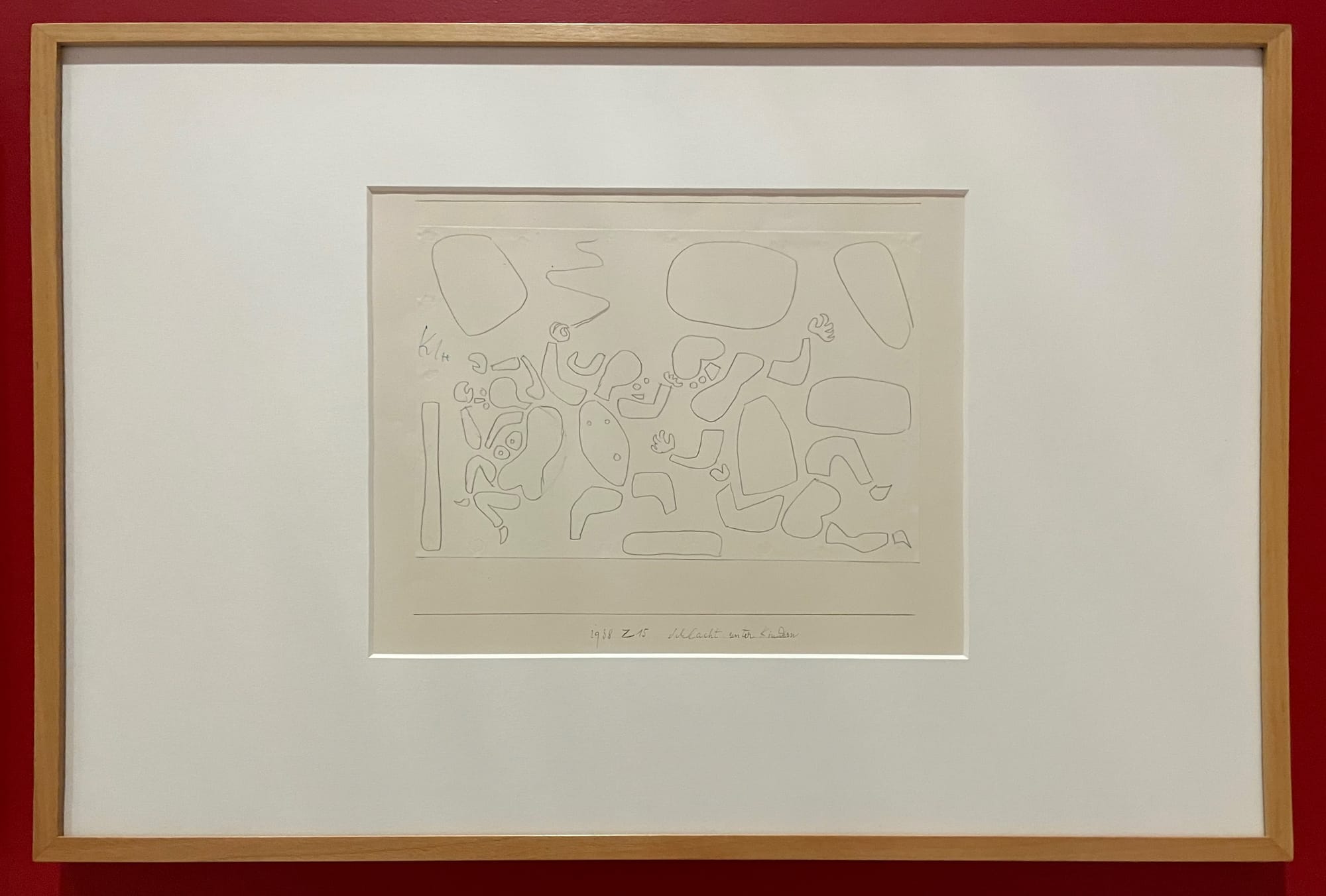
Klee’s political voice does come through in an important but unassuming part of the show: Across a series of unruly chalk-and-pencil drawings displayed in cases in the center of the galleries — easily eclipsed by the vibrant paintings on the walls — are lots of kids. Klee was and still is unique in his capacity to see the world through grown-up and youthful eyes, and to respect the wisdom of children. Drawings of what he called the “national-socialist revolution” portray violence and authoritarianism, many with an emphasis on youth. Ranging from the chilling “Child Murder” (1933) to the horrific “Child-Eater” (1939) to the anarchic “Difficult Children” (1933) and “Battle Among Children” (1938), they reflect the artist’s sympathy and insight into the dangers at the wild frontier of childhood. The illustrations don’t seem to specify an age group, though, and suggest that the real-world dangers are adults in power acting juvenile, pantomiming world domination and demagoguery, resulting in actual death.
These drawings are the exhibition’s hidden treasures — and its most timely pieces. If war, fascism, and dangerously infantile leaders are the subjects at hand, it’s a shame that no mention is made of those laying waste to the world today. Barbarism didn’t end when the Third Reich fell.
Paul Klee: Other Possible Worlds continues at the Jewish Museum (1109 Fifth Avenue, Upper East Side, Manhattan) through July 26. The exhibition was curated by Mason Klein.