The Artist Sculpting World Cup History Out of Gum Wrappers
Lyndon Barrois's “sportraits” depict political protest, the fight for equal rights, and soccer's most iconic moments, some of which FIFA would rather forget.

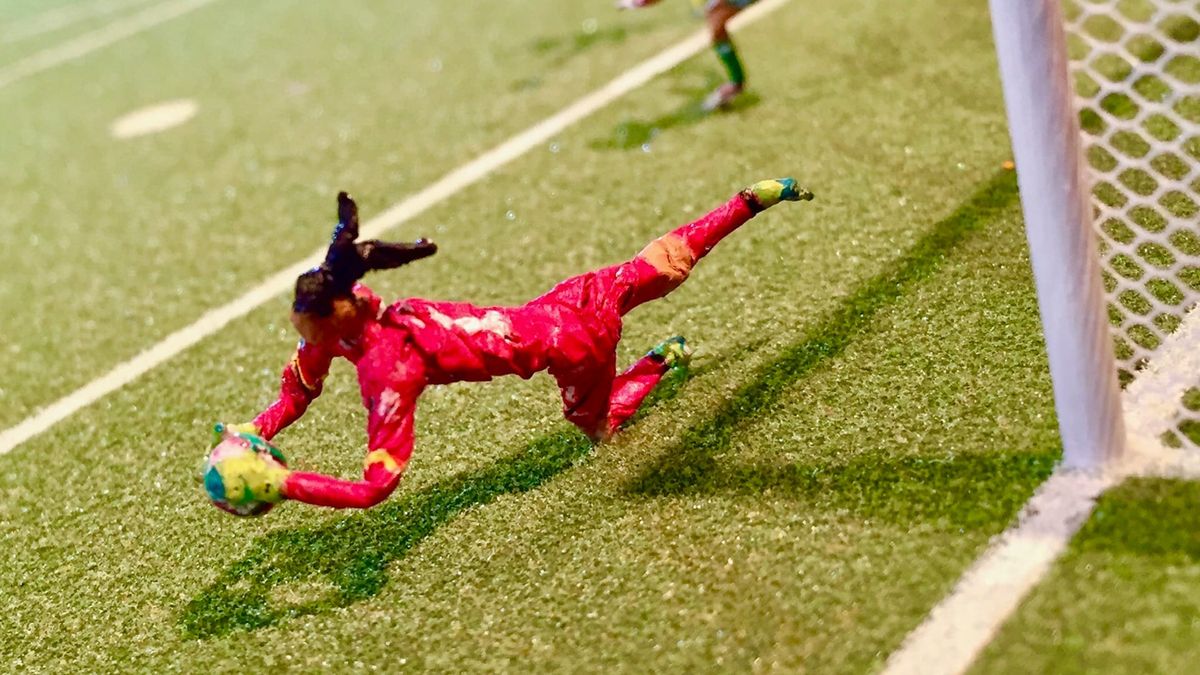
LOS ANGELES — Frozen mid-leap, the soccer star Kylian Mbappé is projected onto a massive, larger-than-life screen. Upon closer inspection, the monumental image commanding the Los Angeles County Museum of Art’s (LACMA) Resnick Pavilion is a tiny, one-inch (~2.5 cm) sculpture. Its body, carefully crafted from a Wrigley’s chewing gum wrapper, sits beneath a camera that projects its image in real time onto a screen. This installation is the work of Lyndon J. Barrois, Sr., whose solo exhibition Fútbol Life: Animated Sportraits is currently on view.
The show arrives in Los Angeles at a pivotal moment, with SoFi Stadium hosting FIFA World Cup matches, including a quarter-final match set to take place tomorrow, July 10. For this exhibition, Barrois recreated crucial moments from FIFA history dating back to the 1930s, illustrating events both on and off the pitch. Notably, it does not shy away from addressing the sport’s negotiations with spectacle, politics, and power. Rather than settling for the version of history captured by the camera, Barrois rebuilds it by hand and, in doing so, decides whose stories are memorialized on a monumental scale.
Left: Lyndon Barrois, Sr. (photo courtesy the artist); right: Barrois creating his sculptures in his studio (photo Sigourney Schultz/Hyperallergic)
Barrois began crafting miniature figures during his childhood in New Orleans, Louisiana, first fashioning drivers for his Hot Wheels cars. During a recent studio visit, Barrois excitedly asked if I wanted to see some of the originals, then pulled out a tin containing every sculpture he had made since he was 11. Walking me through entire soccer teams, he described each player by their position, personality, and physical build. Every sculpture begins as a blank form, and choosing which player it becomes, he explained, is like casting an actor for a role. Individuality and likeness are captured through the subtlest differences in posture and silhouette.
The desire to bring his sculptures to life ultimately led Barrois to pursue a career in animation and visual effects at the California Institute of the Arts in the early 2000s, as the technology began to enter film. (He went on to direct character animation for iconic franchises such as The Matrix.) When I asked about the exhibition’s significance, he described it as a full-circle moment, a chance to return to the sense of childlike play and humble materials that started it all.
The highlight of the exhibition is Barrois’s dioramas, which he calls “sportraits” — miniature freeze-frames of triumph, hardship, political protest, and the fight for women’s and LGBTQ+ rights that FIFA’s official history has largely turned a blind eye to.

In one “sportrait,” a man is carried triumphantly off the field on the shoulders of celebrants. Though their faces are miniature, the joy and elation in every gesture are palpable. The man being carried is Joe Gaetjens, a Haitian-born soccer player who represented the United States at the 1950 FIFA World Cup. His diving header in the 37th minute secured a 1–0 victory over the heavily favored English team — a result so improbable that newspapers around the world assumed it was a misprint.
Gaetjens returned to Haiti a national hero, but the country’s political climate was growing increasingly tumultuous. François “Papa Doc” Duvalier declared himself president for life in 1964, prompting Gaetjens’s family to flee while Joe stayed, believing his status as a sports figure would protect him. Due to his brothers’ political opposition to the regime, however, he was captured by the militia and imprisoned at Fort Dimanche in Port-au-Prince, notorious for torture. He was never seen again, and details of his death were never revealed.

While no footage exists of Gaetjens’s historic goal, the photograph of the moment after — him smiling coyly as he’s being lifted off the field by adoring fans — became the enduring image of his legacy. Barrois memorializes his story through this image, refusing to let the violent erasure of his life silence his humanity.
Where Gaetjens’s image anchors his remembrance, decades later, contemporary fans use the Cup’s stage to fight for visibility. When Mahsa Amini died in the custody of Iran’s "morality police" in September 2022, women took to the streets in a nationwide protest, burning their hijabs and cutting their hair in solidarity and outrage. Nine weeks later, Iranian fans seized the world stage, using their team’s match against Wales at the Qatar World Cup to make their demands heard.
Barrois memorializes this moment through the fans’ signage: One reads “Let Iranian Women Enter Their Stadiums,” the flag’s red, white, and green emblazoned across the words, with two female figures standing on either side. Another fan holds up a jersey bearing the number 22, a direct memorial to Amini’s age. A third sign reads: “Women. Life. Freedom. #MahsaAmini,” representing the fight for bodily autonomy, the right to live without fear, and political freedom. Barrois insists that the stadium is not just a site for sport, but also a contested space for visibility, protest, and the ongoing fight for women’s rights.

Next to the exhibition’s diorama vitrines, a monumental shadow falls across the gallery wall, tracing the silhouette of a life-sized sculpture — a woman mid-kick, her ponytail frozen in midair. The player memorialized at this scale is Marta Vieira da Silva, known simply as Marta, the most decorated player in World Cup history. With 17 World Cup goals, more than any man or woman in history, and six FIFA World Player of the Year awards, she is nicknamed Rainha — “Queen”— in Brazil. Making Marta life-sized is Barrois’s quiet corrective to a culture that has long treated women’s soccer as secondary.
Barrois’s sculptures are acts of reclamation, reshaping whose stories get remembered, one gum wrapper at a time. In deciding who becomes monumentalized, he builds a more inclusive archive of soccer’s history, restoring figures the camera overlooked. The Mbappé projection greeting visitors at the pavilion’s entrance conveys Barrois’s statement in scale: magnifying the miniature to monumental heights, so that intimate human stories finally command the room.


Installation views of Fútbol Life: Animated Sportraits (photo Sigourney Schultz/Hyperallergic)


Left: Installation views of Fútbol Life: Animated Sportraits; right: Barrois in his studio (photos Sigourney Schultz/Hyperallergic)
Fútbol Life: Animated Sportraits continues at the Los Angeles County Museum of Art (5905 Wilshire Boulevard) through July 26. The exhibition was organized by the museum.