The Queer Surrealists Who Fought Nazis With Paper Bullets
Claude Cahun and Marcel Moore shared a magnificent life as both romantic and creative partners, one in which gender proved as mercurial as the political climate of World War II.
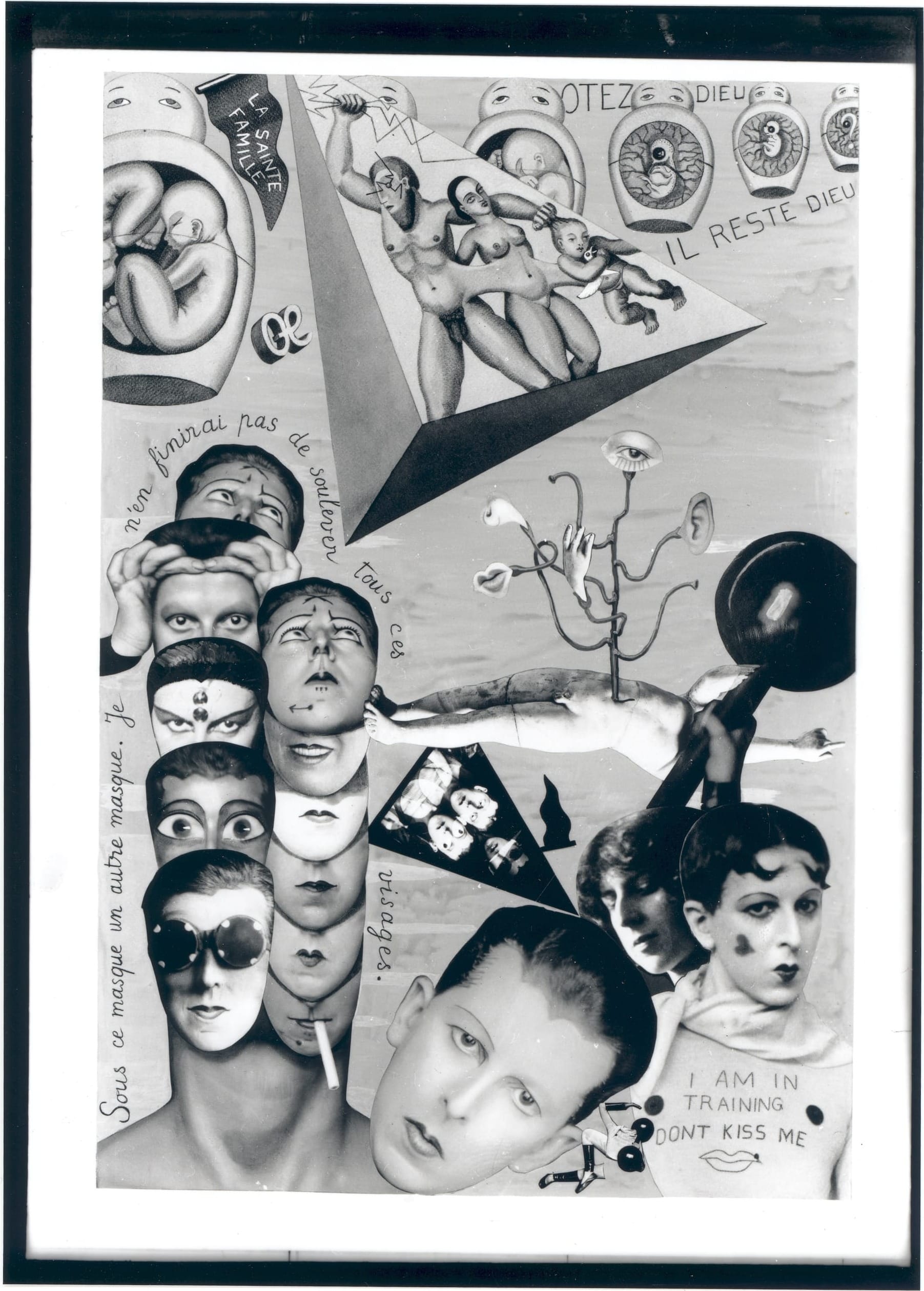
ST. LOUIS — “Beneath this mask, another mask. I will never be finished removing all these faces.”
This line from a photocollage created by Claude Cahun and Marcel Moore speaks to the magnificent, magnanimous life they shared as both romantic and creative partners — one in which gender and familial identity proved as mercurial as France’s tumultuous political climate in the 1920s and ’30s. Born Lucy Renee Mathilde Schwob and Suzanne Malherbe, respectively, the two met as teens in their hometown of Nantes and fell recklessly in love. They then became legal stepsisters when Moore’s widowed mother married Cahun’s divorced father in 1917, a cover for their queer partnership that enabled them to cohabitate the rest of their lives. Moving to Paris in 1920, the pair adopted the pseudonyms Claude Cahun and Marcel Moore, and quickly became imbricated in the circles of the artistic avant-garde — producing Surrealist illustrations, photographs, and collages that drolly deconstruct gendered archetypes.
These delightfully strange black-and-white works, few exceeding five by three inches, form the crux of the Contemporary Art Museum St. Louis’s exhibition And I Saw New Heavens and a New Earth: The Partnership, Art, and Activism of Claude Cahun and Marcel Moore. With a scope and potency beyond the modest length of its checklist, the show celebrates the couple’s eclectic output as a reflection of the queerness of both their union and artistic collaboration.