The Story of Printmaking Is the Story of Democracy
Holly EJ Black deftly weaves a narrative that integrates varied geographical and cultural perspectives, centering figures who may not have been artists themselves.

In an age of visual overload, it’s easy to forget that endlessly available pictures of people, places, and things were once exceptionally rare. So scarce, in fact, that artistic representations were mostly reserved for religious ritual and sacred spaces, for specialized education, or for the very wealthy. Printmaking was arguably the first, and most lasting, innovation counter to such exclusivity.
Holly EJ Black’s The Story of Printmaking: A Global History of Art (2026) traces a medium that has too often been under-appreciated. It’s been relegated as secondary to painting or sculpture, for example, even as prints have been essential to the dissemination of religious belief, intellectual history, and artistic understanding, and functioned as engines of propaganda and protest. As prints were the first mass-duplicated and widely distributed art objects, the history of printmaking is fundamentally a history of the democratization of art. And we could all use a little more democracy right now.
Black’s book is an ideal introduction to the art form. While the lofty title is a lot to live up to, the author wisely leans on the “story” component to paint an engaging picture of time and place, while resisting a didactic urge to cover everything. She focuses on works on paper and, as she states early on, “I could never claim that this is a comprehensive chronicle — what one book could be? — but it does aim to promote a far greater understanding of the enormously rich and varied world of printmaking.” Her book is thorough but not exhausting and well illustrated, and contains a helpful glossary (often overlooked these days). I am firmly pro-glossary — anything to keep me from picking up my phone or opening my computer when I should be reading, and I consulted this one regularly.
Black herself is, likewise, an ideal guide to the art form. She studied it as an undergraduate at London College of Printing, and her clear grasp of the material processes behind the creation of prints adds welcome clarity. It is not a simple task; as she concedes, “the term ‘print’ can be used to describe an almost baffling number of techniques.” But she tackles those techniques — from woodblock to aquatint and many others — with lucidity. As a reader with a longstanding interest in prints but zero hands-on experience aside from a carved potato in grade school, this is a real boon.


The book opens with a visit to a college library where Black sees a photocopied sheet depicting St. John the Evangelist, the patron saint of printmakers, taped to a wall near the copier. It’s a pithy example of both the long continuity of prints and the gulf between “work that emerged sticky with ink and impressed with a design born from a freshly carved block of wood” and “a facsimile dragged from the internet and broadcast through a screen as pixels, before being reconstituted through electronic data via a humble inkjet machine and affixed onto a cheap sheet of A4.” And yet her account more than adequately bridges the gap between past and present, illustrating the continued importance of printmaking in the modern world, from Shepard Fairey’s screenprinting-style street art during the Obama presidential campaigns to Paula Rego’s Abortion etching series that appeared in Portuguese newspapers before a second referendum on abortion rights was narrowly approved in 2007.
Where many histories of printmaking too often begin with Gutenberg and the European Renaissance, Black begins in the Gobi Desert in China with the Mogao Grottoes, also known as the “Caves of a Thousand Buddhas.” In 1900, a Daoist monk discovered a 16.4-foot-long (five-meter) scroll there, now called the “Diamond Sutra” (11 May 868 CE), “the oldest printed and dated book ever discovered.”

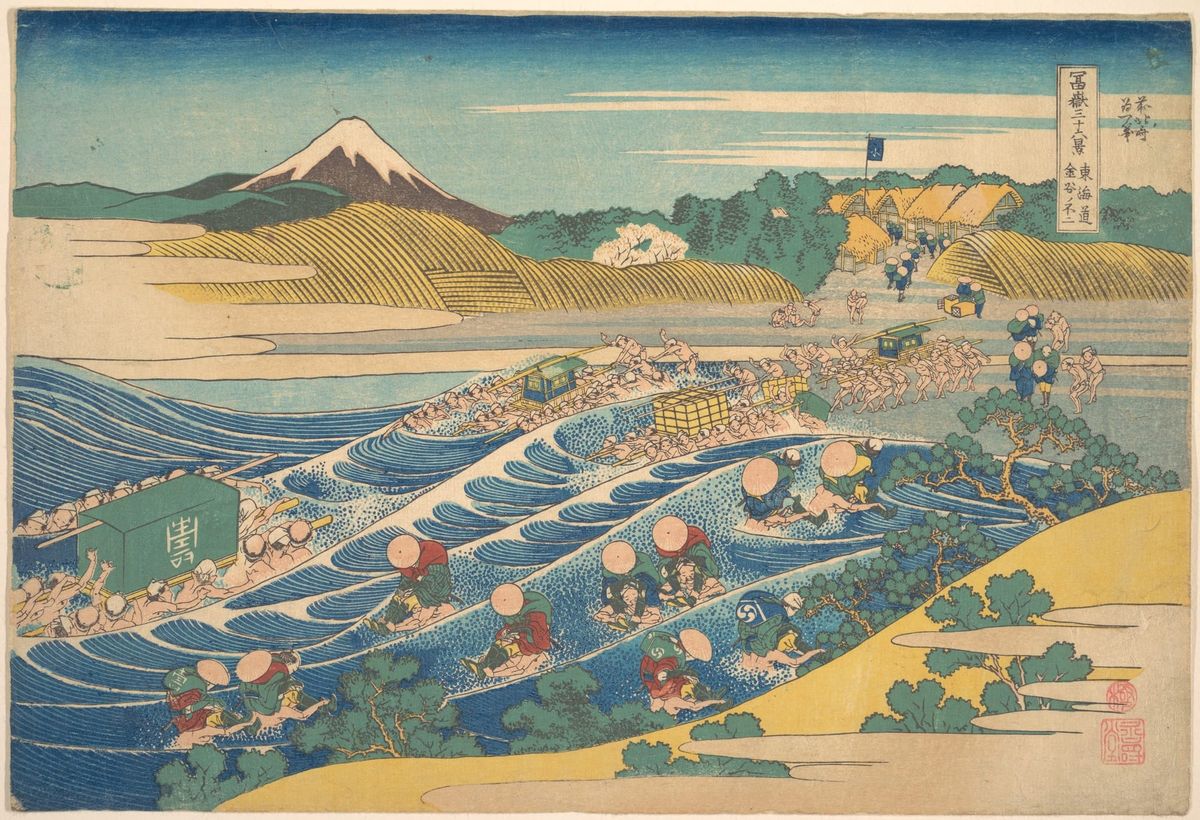
From here, Black deftly weaves a story that integrates varied geographical and cultural perspectives and includes figures central to printmaking who may not have been artists themselves, not least women rulers and publishers. That said, there are plenty of the usual suspects, from European artists like Albrecht Dürer, Rembrandt van Rijn, William Hogarth, and Francisco Goya to influential Japanese artists such as Utagawa Hiroshige and Katsushika Hokusai. Refreshingly, Black also includes Katsushika Ōi, “known officially as Eijo,” who was Hokusai’s daughter and “ghost brush” as his assistant, as well as the sole designer of An Illustrated Handbook on Daily Life for Women (1847), among other works.
Equally unexpected, but very welcome, are the inclusion of some personal favorites, like German artist Max Klinger, whose disturbing psychological etchings — I highly recommend Paraphrase on the Finding of a Glove (1877–78) — had a big influence on Edvard Munch. Another was Mexican printmaker José Guadalupe Posada, whose grinning calaveras comforted Frida Kahlo and Diego Rivera in 1933 New York and contributed mightily to the look of the 2017 Disney/Pixar film Coco.


While the later chapters may occasionally feel overly dense, with dozens of figures and myriad organizations over a handful of pages, it’s perhaps a fitting pace for this art form. The history of printmaking is one of velocity, and even in a digital world, its political power as well as its pleasures are unmistakable.
Remarkably, Black’s book ends where it begins: with a series of color aquatints by Ethiopian-American artist Julie Mehretu titled Six Bardos (2018), inspired by her own visit to the Mogao Grottoes.
The Story of Printmaking: A Global History of Art (2026) by Holly EJ Black is published by Yale University Press and available online and through independent booksellers.