The Unruly Politics of Glitter
In the visual arts, glitter has been used to make the presence of such marginalized identities impossible to overlook.


It’s a cold Saturday afternoon in downtown San Francisco. Despite the weather, the streets are crowded with determined shoppers. I’m feeling rather pleased with myself, having just scored a pair of jeans at 50% off, when I wander into one of those shops that sell nothing but Christmas decorations. After a few minutes wading through a thicket of fake trees, Santas, and reindeer, I’m about to turn around to leave, when I see it.
Presented with improbable dignity in a golden box is a hanging ornament in the shape of the Trevi Fountain that comes with a “complimentary papal blessing.” Its roughly shaped details would be dull if the whole thing weren’t drowned in glitter. Under the shop lights, this perfect miniature of late Baroque architecture explodes in shine: a beacon promising a brighter future and a better life.
Although it might be best known for its seasonal cameos at Christmastime, glitter turns up nearly everywhere, from cosmetics to credit cards to, of course, contemporary art.

The material has a resolutely American story. Its beginnings trace back to the late 1930s, when Henry Ruschmann, a German immigrant, patented a high-speed machine for cutting photographic prints, which produced small, glossy cellulose “schnibbles” as waste. When his employees began taking these discarded fragments home to use as artificial snow, glitter was born. Today, Ruschmann’s company produces every imaginable variety, from fluorescent and holographic to biodegradable, responding to growing concerns about microplastics.
In his short 1979 ssay “Light in its Artistic Manifestations,” Hans Sedlmayr identifies “phototropic eras” defined by the discovery of new luminous materials and their artistic use: bronze, Greek marble, Byzantium’s golden glass mosaics, oil paint. It’s a shame that his study ends with mirrors in 17th-century France, as glitter surely deserves inclusion.

Beyond reflecting and refracting light, glitter flattens the surfaces it adheres to — cover a sculpture in it, and dimension dissolves into a twinkling veneer. Andy Warhol’s famous remark that to understand him, one need only look at the surface of his paintings resonates in his use of diamond dust. Though not technically glitter, this pulverized glass conveys the same message: glamor achieved cheaply and mass-produced, a symbol of 20th-century American consumerism.
Perhaps relatedly, glitter is often dismissed as frivolous. As Nicole Seymour notes in her 2022 book on the subject, it is “typically associated with marginalized identities and subject positions including children, girls, women, feminine people, drag performers, queer people, transgender people, and people of color — categories that, of course, overlap in various ways.”
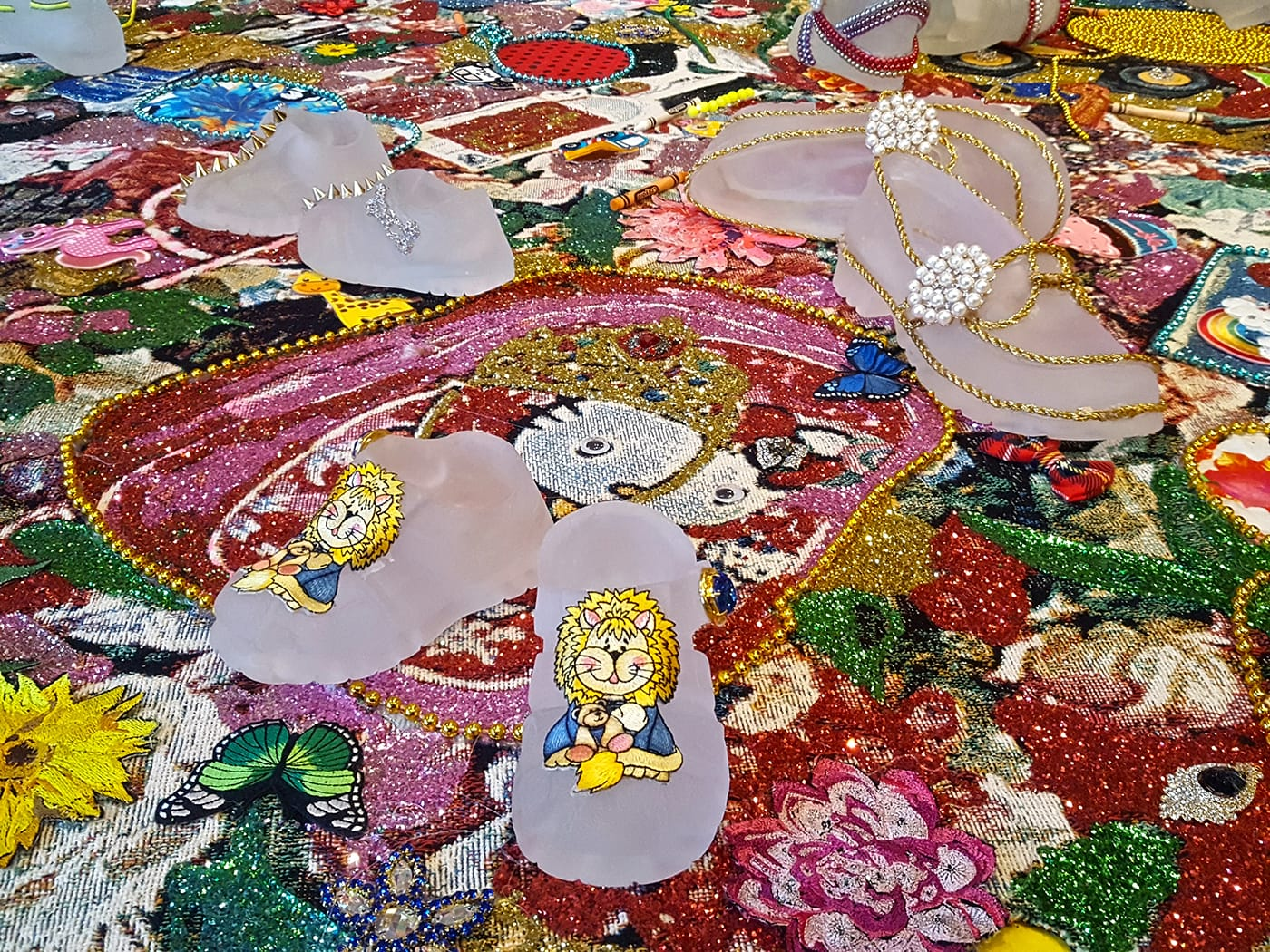
Indeed, its association with queer culture emerged with drag performances in the 1950s and persists today in the form of costumes, makeup, and performances in widely popular TV shows such as RuPaul’s Drag Race (2009–present).
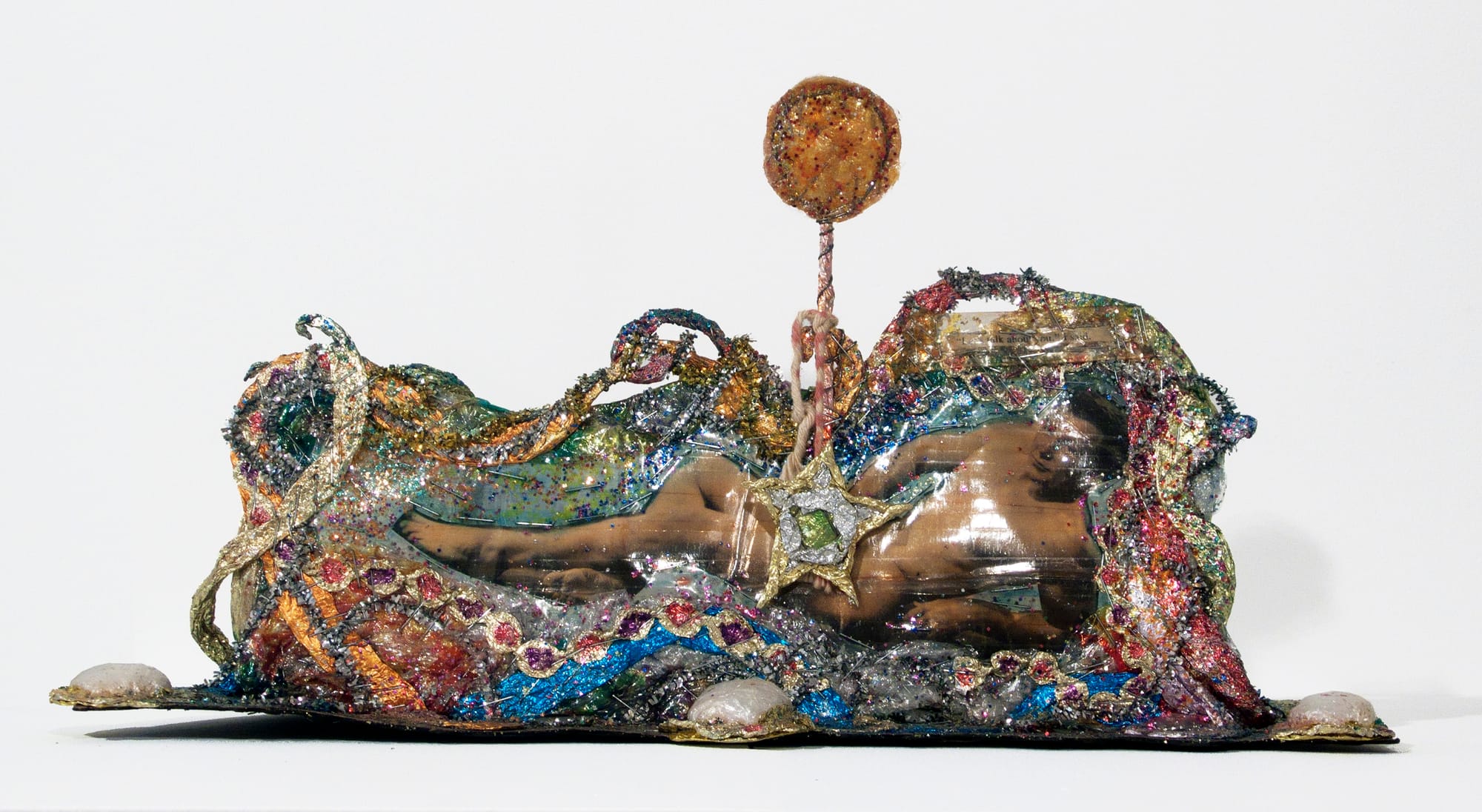
In the visual arts, glitter has been used to make the presence of such marginalized identities impossible to overlook. In the work of Thomas Lanigan-Schmidt, glitter transforms everyday materials like cardboard and plastic into richly textured surfaces that evoke spiritual transcendence, camp aesthetics, and queer ornamentation, turning kitsch into devotion.
Glitter also allows marginalized racial and ethnic communities to push back against imposed stereotypes. Quil Lemons’s 2017 photographic series GLITTERBOY features young Black men with their cheekbones dusted in glitter, highlighting how social expectations restrict expressions of identity and behavior outside hypermasculine norms. Here, shimmer becomes a visual insistence on visibility.
These layered meanings, as well as the material’s longstanding association with “lower” forms of art, might explain why the art market is hesitant to embrace glitter-laden artworks. A recent walk around Art Basel Miami last December confirmed as much. Searching for sparkling canvases in this temple of the (mostly) American art market, I came across a multimedia 1990 painting by Lucio Muñoz, a couple of shiny tapestries by Ebony G. Patterson and Yvette Mayorga, and a colorful painting by Chris Martin. A canvas by Mickalene Thomas briefly engrossed me in its booth, though its shimmer came from rhinestones, a material better suited to her carefully controlled compositions.

That same evening, on my way to dinner, I wandered into a hotel lobby suspiciously repurposed as a small art fair. Amid derivative pop and graffiti art, I finally found the holy grail of glitter: swarms of iridescent butterflies and dubious portraits of Hollywood actors, all gleaming under a thick coat of sparkle. Indulging in this Salon des Refusés of shine, I began to notice the audience around me: blazers encrusted with cabochons, mirror dresses, miniskirts in lurex and lamé, iridescent scale tops …
Had Sedlmayr lived long enough to witness this after-hours fair, he might have revised his chronology. Light slipped out of the grand halls of Versailles and into the margins, where it became unruly, synthetic, and defiantly cheap. Glitter does not monumentalize light; it democratizes it. And perhaps that is what makes it so difficult for some of the contemporary art world to accept.