The Venice Biennale's Sham Awards Cannot Artwash Genocide
This year’s historic actions demonstrated that Israel’s unspeakable assault on Palestine will not be ignored — and that the power of boycott has never been greater.
This Sunday, the Venice Biennale will award its new “Visitors’ Lions.” But no matter who receives this poisoned chalice, the results are void.
Stripped of the silver and gold they wore in previous iterations of the Biennale, the new Lions have been thrown to the tourists; “Best Artist” and “Best National Pavilion” will be decided by a popularity contest. Why this surprising democratic turn? The expert jury initially appointed to give these honors resigned en masse in April of this year. These resignations were, in part, the result of the Art Not Genocide Alliance’s (ANGA) nearly three years of campaigning to exclude the Israel pavilion from the art world’s most important biennial. After the jury publicly stated their intention to omit Israel and Russia from consideration for the Golden Lions, they were visited by representatives from Italy’s Ministry of Culture. The contents of the meeting are not public, but we can surmise how it went from the jury’s subsequent unanimous resignation. Shortly after, the Venice Biennale Foundation announced the Visitors’ Lions, inviting ticket-holders to cast their vote for awards to be announced at the end of the show’s run.
“Our exclusion has been thwarted, and the choice now passes to the general public,” crowed Israeli Foreign Minister Gideon Sa’ar, whom human rights groups accuse of orchestrating the siege of Kamal Adwan Hospital and the notorious imprisonment and torture of the hospital’s director, Dr. Hussam Abu Safiya, in 2024. Firmly siding with torture and against principle, the Biennale made it clear that both Israel and Russia were back in the running for the Visitors’ Lions. As Antonia Majaca observed, the jury dared to apply a criterion, and the Biennale responded by dissolving judgment itself.
Many artists have rejected this sham from the start. On the day the 2026 Biennale opened to the public, 54 artists in the international exhibition and 22 national pavilion teams withdrew from consideration in solidarity with the jury. In June, more than a hundred artists threatened legal action unless their names were removed from the ballot. Sunday’s ceremony awards a prize that few want to win.

The massive public pushback against the Biennale also demonstrates how close we have come to actualizing the moral principle that a genocidal, apartheid state has no legitimacy on any international stage. This year, we participated in a series of unprecedented protests. Biennale artists and cultural workers went on strike three times in seven months — nothing on this scale has ever happened before (not even during the anti-capitalist protests of 1968, which put a stop to the Biennale’s prizes for 18 years). This year’s protests were also unprecedented in terms of the level of collaboration between ANGA — which comprises artists, curators, and precariously employed workers — and rank-and-file labor unions.
The Biennale is resolutely global, unfolding in the “anywhere or not at all” of the international art circuit. Against the false globalization of the art market, our internationalism was grounded in local organizing against Israel’s Zionist genocide.
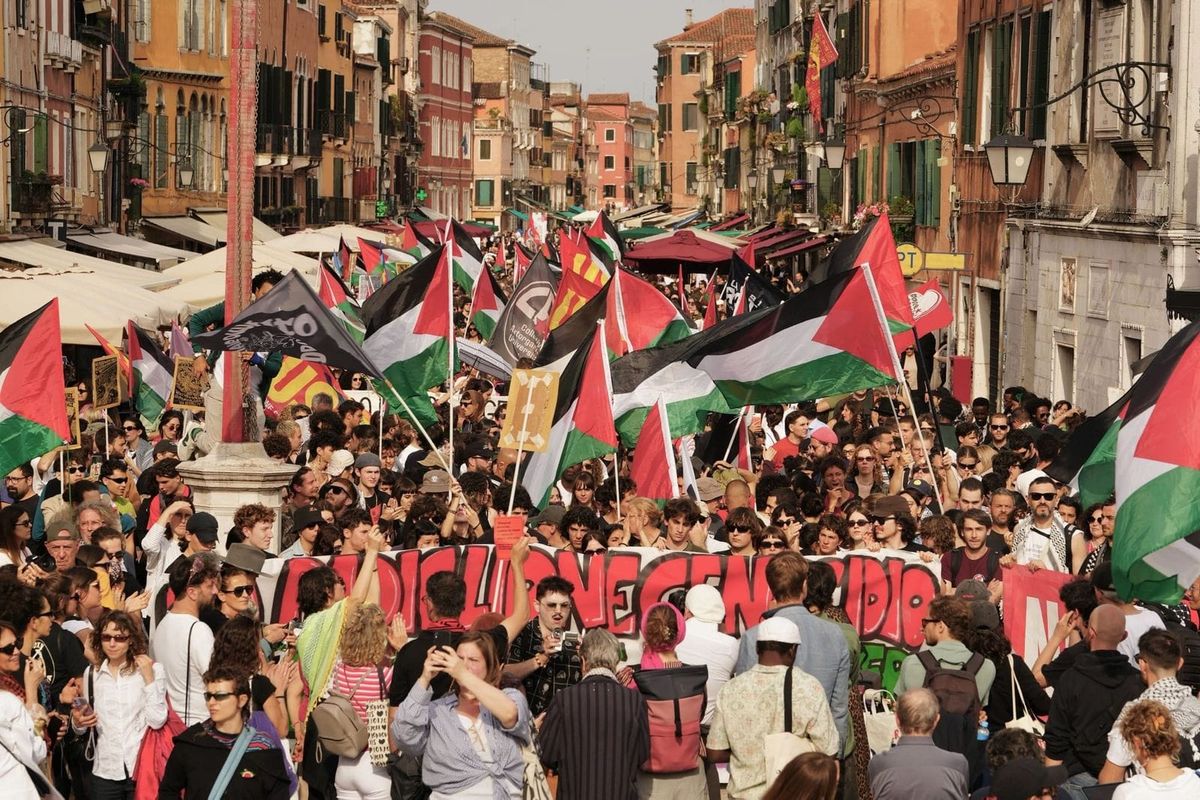
The first of this year’s strikes, on May 8, was built locally in Venice, with Biennalocene, Sale Docks, and other local grassroots unions whose participation provided legal protection for striking art workers. On May 8, 30 of the Biennale’s 100 national pavilions closed partially or fully, and thousands of people marched from Via Garibaldi to the Arsenale, where they were met with police brutality. Many artists in the main exhibition draped or altered their works.
The second strike, on June 12, was national in scale. It was the result of a year of organizing assemblies and actions in about 20 cities all around Italy, with organizations including Mi Riconosci?, Vogliamo Tutt’Altro, Biennalocene, and grassroots unions through the Cultural Strike platform.
The third strike, on 30 October, responded to a call that emerged from outside the art world from the World Federation of Trade Unions and, in Italy, was taken up by militant dockworkers, including the Autonomous Collective of Port Workers, and the grassroots Unione Sindacale di Base. A network of port unions at 113 in 22 countries, including Italy, France, Greece, Turkey, and Morocco, refused to load weapons bound for Israel. This was the biggest ever coordinated action of its kind, and our role was to help build local participation in Venice.
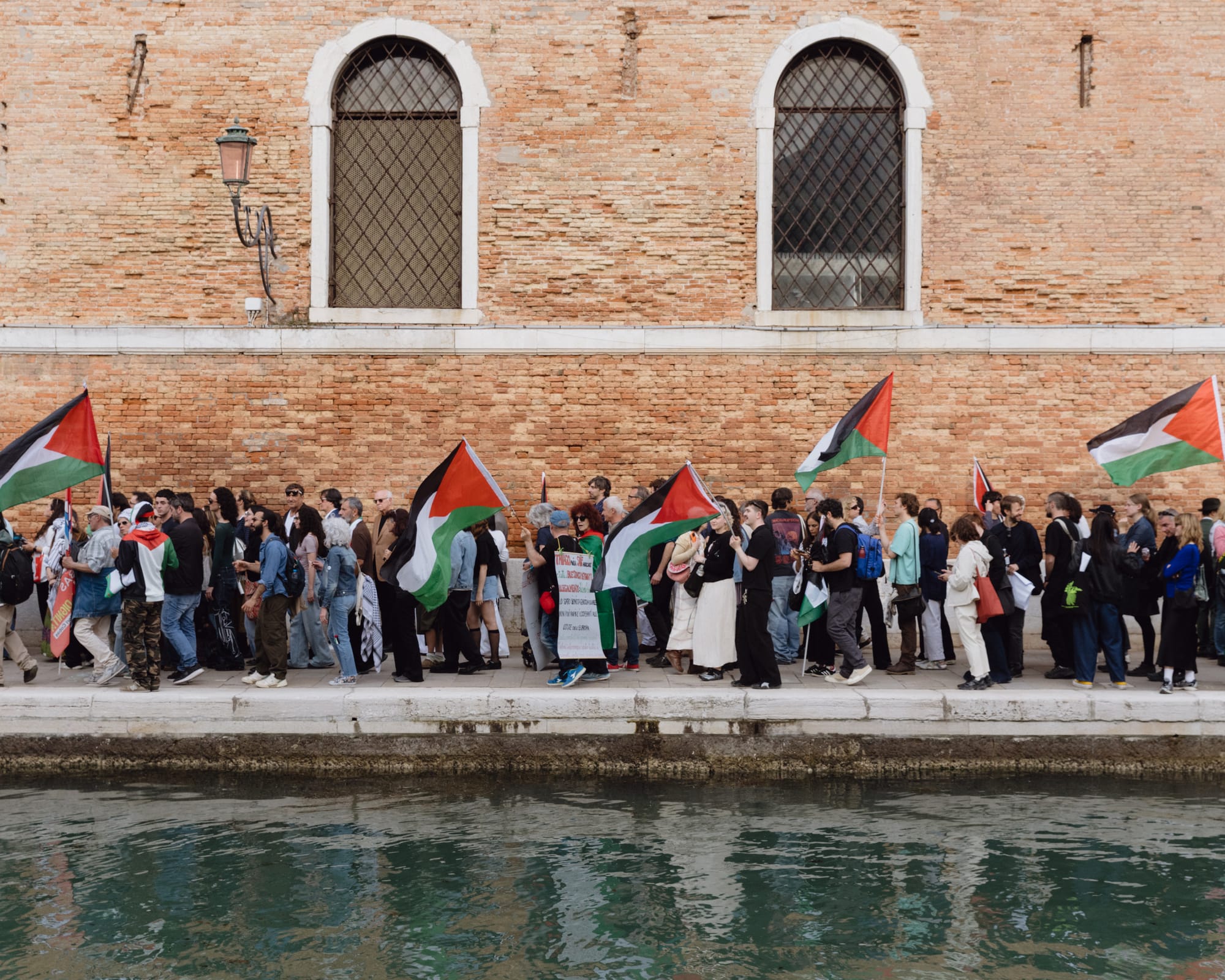
Today, November 20, as this piece is being published, the International Student Strike brought further strike action to Venice, demonstrating the political convergence between students and the Biennale — students in the city are often employed in the cultural sector under precarious conditions.
Our ability to do this grew out of the work we began in 2024, in adherence to the guidelines of the Palestinian Campaign for the Academic and Cultural Boycott of Israel (PACBI) and Boycott, Divestment, and Sanctions (BDS), when our open letter demanding Israel’s exclusion from the Biennale was signed by more than 24,000 cultural workers. That year, the Israel pavilion closed.
Between 2024 and 2026, our campaign connected more substantively with the Italian labor movement. As the June 12 strike articulated, the political atomization of artists is a labor issue, related to the art world’s reliance on precarity, which shifts the risk of political action onto individuals. The Biennale provides no fees or production money to artists, leaving them to fundraise their participation. Those whose work is not sufficiently market-friendly to claw back payment in future sales have to content themselves with being paid in the false currency of prestige.
ANGA refuses the oppressive logic that allows the Biennale to support genocide and profit from precarious labor while claiming to rise above politics. This year, we have made clear that the alliance we have created has the power to disrupt the Biennale’s functioning and change its nature.
Today, the contradictions of the present political order — the indigestible, white-supremacy-coded cocktail of Europe’s simultaneous opposition to Russia and support for Israel; the flailing, ever-dying economy; the oceans of money poured into technologies of death and destruction — explode messily into the supposedly morally hermetic market-world of the Biennale.
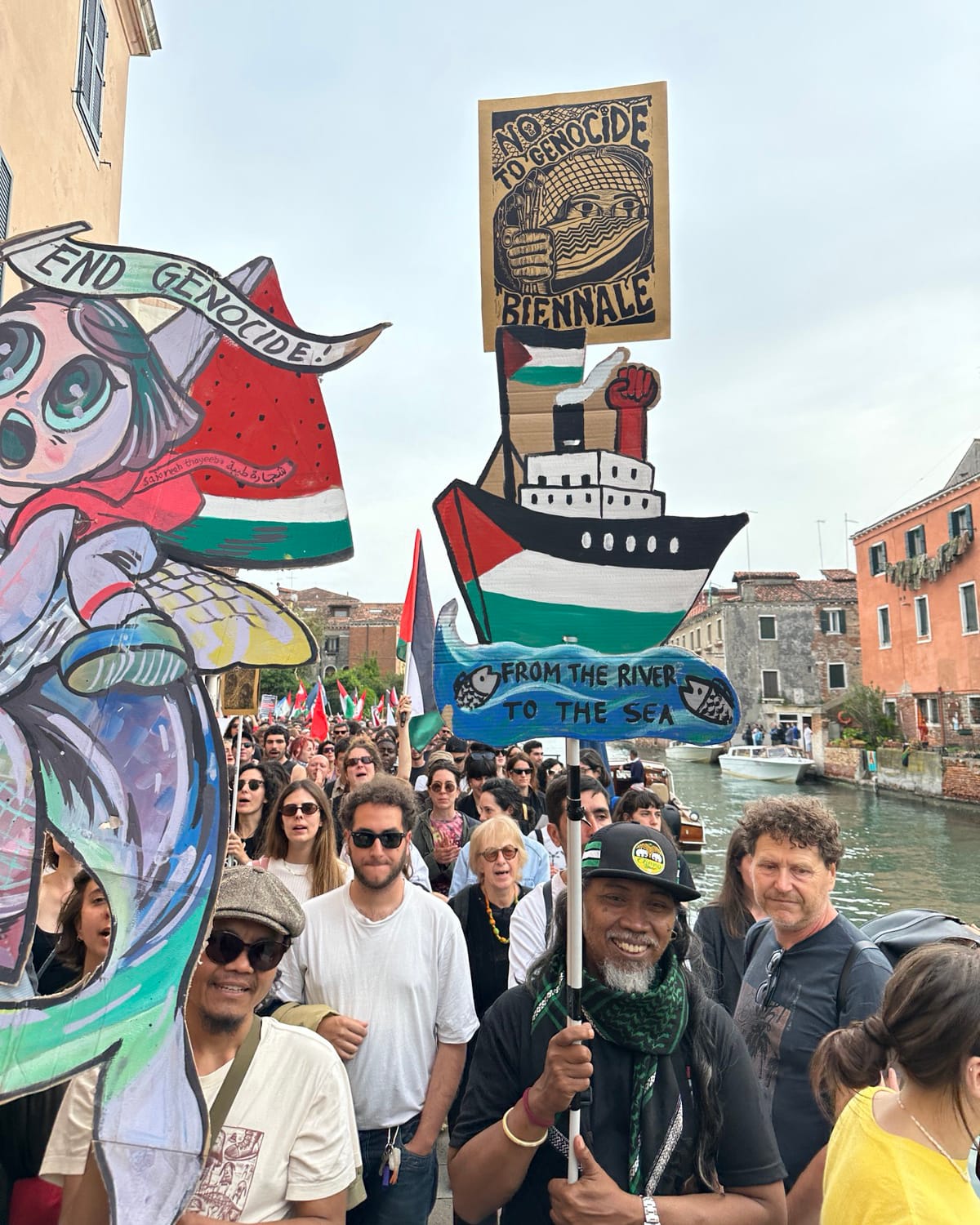
The farcical “Visitors’ Lions” are the Biennale’s wager that the walls can always be painted pure white again. But this year’s massive actions have demonstrated that we will not allow Israel’s unspeakable assault on Palestine to be art-washed and ignored. ANGA’s members and supporters are no less steadfast than we were three years ago, when our campaign first began. It remains obvious and undeniable that Israel, the United States-backed abattoir-state, must not be allowed to bring its logic of butchery to be art-washed into neutral “complexity” at the Biennale. And we are now considerably more organized and better connected to the wider struggle against Zionism.
When we look back to ANGA’s beginnings, in early 2024, we remember a time when the shock of total Zionist impunity was still raw enough to feel unreal. We could not imagine that friends or colleagues could disagree with this basic principle. We were soon disabused, as many cultural workers washed their hands of blood in service of their careers.
But our collective efforts have transformed this anti-political status quo. The new compositions of struggle made possible by the mass revolt against Zionism offer a model for how the art world can reach beyond the isolated precarity of cultural labor into new alliances — with students, with dockworkers. The power of boycott as a tool has never been greater. We continue to remake the Venice Biennale, the modern world exhibition, from Walter Benjamin’s “place of pilgrimage to the commodity fetish” into a site of struggle.