Trevor Winkfield’s Cheerfully Sinister Worlds

His rejection of certainty is an urgent reminder that imagination should not be neglected in the pursuit of art.

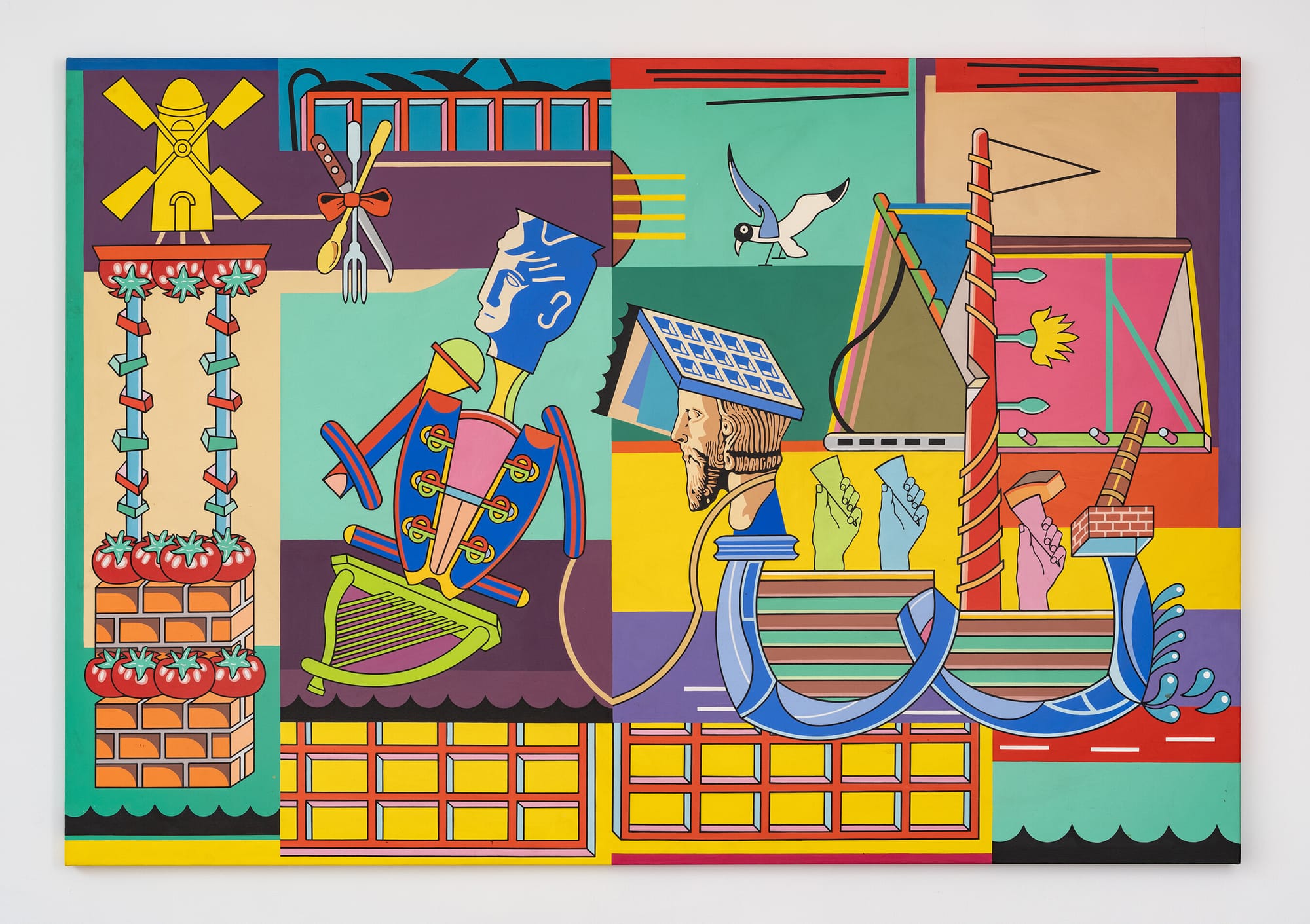
Trevor Winkfield, "Voyage II" (1996), acrylic on linen (all photos courtesy Tibor de Nagy gallery)

The English-born Trevor Winkfield has taken a unique path that has yet to be fully recognized for its unlikeliness, depth, and breadth. After attending art school in Leeds and getting his master’s degree from the Royal College of Art in 1967, he moved to New York in 1969, where he continued to publish a poetry magazine, Juillard (1968–72), and made a name for himself among a group of writers and artists known as the New York School. He worked for Arthur Cohen, who sold books and ephemera on 20th-century Modern Art movements such as Dada and Surrealism and made entries to Cohen’s encyclopedic catalogs. These were informative, succinct, and witty. He was a polymath whose knowledge of minor artists and writers, such as Gerald Murphy and Ronald Firbank, was unmatched.

In 1976, Winkfield began painting again, made book covers, and collaborated with poets such as John Ashbery, Charles North, Ron Padgett, and Harry Matthews. He had his New York debut exhibition in 1977, and published his translation of Raymond Roussel’s How I Wrote Certain of My Books. Roussel, who is widely considered the most eccentric writer of the 20th century, wrote according to linguistic rules based on homophones, words that sound similar but have different meanings. As one might expect, in the years since, critics have tried to connect Winkfield’s collage-like paintings of artificial worlds with Roussel’s wildly improbable novels, but have never discovered the key, which I feel was never there. As literary as Winkfield is, he is equally a visual person. This complete duality is what makes him inimitable.
Trevor Winkfield, "The Astrologer" (2001), acrylic on linen

Winkfield paints on a table; the eight works in The Mermaid’s Revenge - Paintings 1991-2001 at Tibor de Nagy gallery come from a decade when Winkfield had access to an apartment where he was able to work on what were for him large-scale surfaces. Done in acrylic on linen, they measure between 35 1/2 x 19 1/2 inches (~90.1 x 49.5 cm) and 45 x 72 inches (~1.1 x 1.8 m). The size of none of the works is the same. All of them are packed with details meticulously done in flat, saturated, playroom colors, which are interrupted by a volumetric detail done in a straightforward, illustrative style. One reason for this disruption is that Winkfield doesn’t want us to read the paintings as airless and flat. He has conjured an artificial world — simultaneously brightly colored, slightly sinister, and cheerfully incomprehensible — usually inhabited by a delicately featured young man engaged in a mysterious activity.

The painting’s titles underscore the solitary nature of the tasks being undertaken: “The Navigator” (2000), “The Student” (1999), ”The Astrologer” (1991), and “Self-Portrait” (2001), with its palette and carefully depicted daubs of paint. Each figure could be a surrogate for Winkfield, an artist and writer who has written smart and original pieces on Georges Braque, Jasper Johns, John Graham, and Florine Stettheimer, collected in Georges Braque and Others: The Selected Art Writings of Trevor Winkfield, 1990–2009 (2014).

Trevor Winkfield, "The Student" (1999), acrylic on linen

In “The Student,” a young man wearing a helmet that includes a fish and what might be a lock for an eyepiece is holding a long-handled pot beneath a lightbulb that is releasing tokens marked by a snowflake pattern. The tokens reappear in the sky above the pink and pale-blue mountain seen in the open window. The student’s body and clothes are made up of separate parts, with his oversized hands and bare feet painted different colors, including celadon and orange. The flatness of the shapes suggests we are looking at an intricate shadow puppet engaged in an activity whose meaning we will never unravel. 

The hermetic nature of Winkfield’s paintings might be off-putting to some, but not to me. I think his devotion to creating a completely artificial world is a necessary and important counterpoint to the art world’s belief in literal meaning and transparent, socially conscious subject matter. His rejection of certainty and the comfort it supposedly provides is an urgent reminder that imagination should not be neglected in the pursuit of art, and of the freedom it can give you. In the unlikely synthesis of bright colors, incomprehensible behavior, and compelling scenarios, we are invited to enter a meticulously constructed world unlike any other.

Trevor Winkfield: The Mermaid's Revenge - Paintings 1991 - 2001 continues at Tibor de Nagy gallery (11 Rivington Street, Lower East Side, Manhattan) through July 31. The exhibition was organized by the gallery.