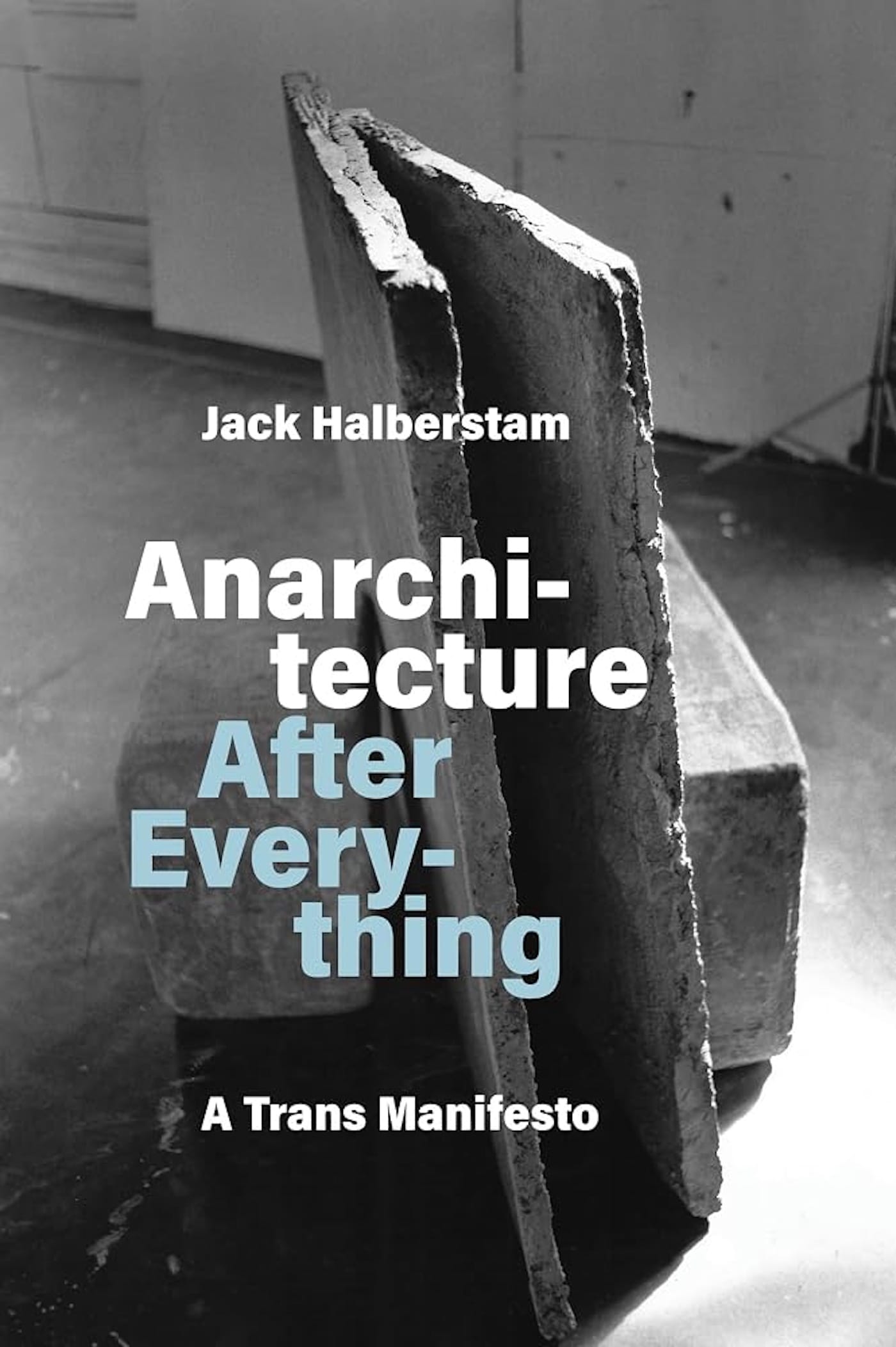
For decades, Jack Halberstam has been extolling the virtues of not doing what we’re supposed to — or not doing anything at all. In 2011’s The Queer Art of Failure, for instance, the pioneering gender and queer theorist posited failing as a form of creative resistance to capitalist concepts of success; in 2020’s Wild Things: The Disorder of Desire, he suggested “wildness” as a force of queer disruption to the status quo; and in 1998’s seminal Female Masculinity, he reimagined masculinity severed from maleness. His latest book, Anarchitecture After Everything: A Trans Manifesto (2026), treads further still into the terrain of queer opposition with a philosophy of unmaking and reorganizing the built environment, which he calls “unworlding,” in order to dismantle heteronormative social structures.
In contrast to “world-building,” which seeks to enact change within the parameters of these systems, Halberstam explains that “an unworld is not simply the opposite of the world we inhabit … An unworld must also unthink the logics of this world that make contemporary life under capitalism seem inevitable and right.”
The book’s thesis is summarized in its first sentence: “Anarchitecture, a set of art practices that emerged in the 1970s out of experiments with the sculpting of abandoned buildings, offers an expansive language for thinking about how bodies (and specifically trans bodies) emerge as a consequence of cutting, breaking, dismantling, and collapse.” Since space and bodies organize our daily lives and larger economic and sociopolitical sphere, “cutting” them isn’t just a symbolic act; as Halberstam writes, it’s about making “strategic cuts into the support system for our unfriendly climate and our racist world.”