Why Do So Many Museums Hold a Convicted Antiquity Dealer’s Treasures?
After The Met returned a Roman bust connected to Phoenix Ancient Art, the question of what will happen to other works sold by the gallery to dozens of US institutions remains open.

The Roman was gone.
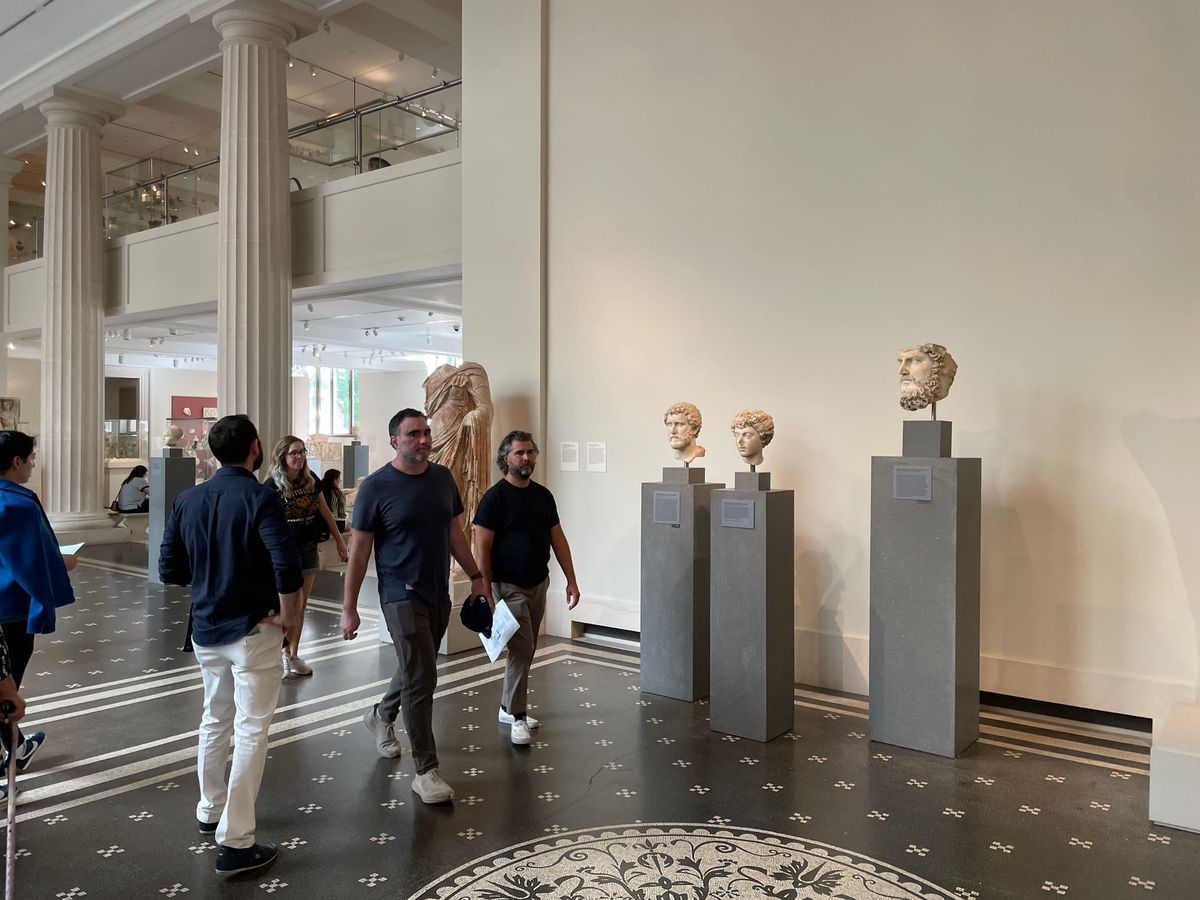
When I went to the Metropolitan Museum of Art a few weeks ago in search of a marble portrait bust of an imperious-looking Roman man, both the sculpture and its pedestal had vanished. Only the label dating the piece to the 2nd century CE remained, marooned on the gallery wall.
The sculpture had been purchased from Phoenix Ancient Art, a gallery purporting to follow “the antiquities trade’s most vigorous and stringent procedures of due diligence.” The gallery touted the effort it put into finding evidence that its artifacts had left their countries of origin long before the enactment of export bans. Equipped with these good provenances, or ownership histories, Phoenix boasted that its antiquities could be “collected in full compliance with all legal and ethical rules.”
The Roman was supposed to be above suspicion. But he was seized by the Manhattan District Attorney’s Office, which gave me a list showing that they have taken a total of nine Phoenix artifacts from The Met, worth nearly $5 million, since 2021 alone. (Three of these were loans.)
A Met Museum spokesperson confirmed that the Roman was repatriated to the Republic of Türkiye this February. The question of what will happen to the other spectacular antiquities the gallery sold, all with equally convincing-seeming provenances and many still sitting in the galleries of a dozen other American museums, remains open.
Phoenix Ancient Art has not responded to a request for comment for this story.
Ali Aboutaam was the key figure in the rise of Phoenix Ancient Art. Born in 1965, Aboutaam began working in his father’s antiquities business in Beirut as a teenager. Business was good in a country whose soil still yielded artifacts from the villas built by Roman merchants who sent ships full of luxuries from the East to Europe. Centuries later, the same Lebanese ports were still the logical launching points for antiquities smuggled in from nearby Syria, Turkey, and Iraq.
Making a living as an international antiquities dealer became difficult when Lebanon’s civil war began in 1975, and went from difficult to impossible when Lebanon banned the export of antiquities in 1988. The Aboutaam family left the country, obtaining Canadian citizenship in 1990. There, Aboutaam registered a company, Hermes Numismatique, which soon received a shipment from Lebanon of 5th-century CE mosaic panels. The largest was an 11-foot-long swirl of geometric patterns that had once covered an entire floor, like a carpet in stone.
Canadian authorities seized these mosaics after determining they had once decorated homes and churches in northwestern Syria. The seized mosaics were repatriated in 1999. Other northern Syrian mosaics that Aboutaam sold in the same period remain in museum collections, including that of Geneva’s Musée d’Art et d’Histoire. (The museum told me that they are in the midst of a “comprehensive provenance research project” to investigate several items in their collections, including the mosaic.)
Media reports on the mosaic seizures didn’t mention Aboutaam’s name. His involvement was visible only to those who dug through court filings and company registrations. Starting afresh, Aboutaam dissolved Hermes and moved his center of operations to Geneva. In 1995, he incorporated Phoenix Ancient Art and opened a sleek gallery space in the city’s historic center.

Soon afterward, Italian authorities arrived to carry out the first of what would be numerous seizures. Phoenix’s storerooms held hundreds of artifacts that had been looted from southern Italy and smuggled into Switzerland through well-known trafficking networks. The gallery had already sold some of these pieces to the elite New York City collectors Michael Steinhardt and Shelby White, who both had to surrender purchases worth millions of dollars. These investigations are still ongoing; just last year, The Met handed over two artifacts that had been looted from Italy and donated to the museum by the Aboutaams.
Aboutaam wasn’t charged with anything in connection with these seizures, since authorities couldn’t determine if he was knowingly buying stolen goods.
Take the 251 artifacts Phoenix surrendered to Italian authorities in 2009. Investigators traced some of these pieces to a temple site overlooking the sea in southern Italy. The looters, who tunneled into the site from a neighboring house, had found so many artifacts that they laid down tracks and used a little miner’s cart to trundle them all out. Still encrusted with dirt, the artifacts had been packed into fruit crates and sent across the border.
Investigators seized the antiquities when they were still in the crates. The gallery put out a press release claiming it had purchased the artifacts “a long time ago, without knowing of their doubtful provenance.” They didn’t explain why its staff, supposedly dedicated to ensuring legal and ethical sales, hadn’t been in the least suspicious about artifacts that so clearly had just emerged from the ground.
Had Aboutaam really been bamboozled by his suppliers? According to the work of journalists Peter Watson and Cecilia Todeschini, as well as my own research into other lawsuits, Phoenix regularly responded to questions about where it had gotten many of the antiquities it was selling by claiming that they actually belonged to Tanis Antiquities, a shell company registered in Saint Vincent and the Grenadines. The trail went dead when investigators couldn’t figure out who owned this company or how it had gotten the artifacts.
In search of clues, I spent days in the records room of the Southern District of New York reading every case I could find involving Aboutaam and Phoenix. Finally, a deposition tucked away in the filings of a 2003 case revealed that Tanis’ owner was Aboutaam himself.
The misadventure with the Syrian mosaics apparently taught Aboutaam how risky it was to have his own name on the paperwork. After that, Aboutaam regularly purchased antiquities through shell companies. These companies then consigned their pieces to Phoenix, leaving Aboutaam free to deny all knowledge of their origins when authorities discovered evidence of looting.
When both of Aboutaam’s parents died in a Swissair plane crash in 1998, the strategy became even simpler. From then on, when caught with a looted artifact, Aboutaam routinely claimed that he had inherited the piece from his father and knew nothing about its origins. This was true, for example, of three sculptures repatriated by Swiss authorities in 2024 after they discovered they had been stolen from Iraqi museums in the mid-1990s. Aboutaam blamed his father — despite having testified in the 2003 case that his father had retired in 1992.

Aboutaam’s strategies for evading the law were still deeply secret in 1998 when the Saint Louis Art Museum paid Phoenix $499,000 for an Egyptian mummy mask. Made around the 13th century BCE, the mask combined linen, plaster, gold, paint, and colored glass to represent a woman with full, elegant lips and almond-shaped eyes.
Soon after the purchase was unveiled, Egyptian authorities recognized the mask. It had been excavated in the necropolis of Saqqara, just outside Cairo, in 1952. Records showed that the mask had remained in storage for decades until a periodic check revealed that it was missing. Egypt demanded the mask’s return.
The museum refused, arguing that the mask had been exported to Switzerland shortly after its discovery and held in private collections. They insisted that Egypt’s records were simply mistaken.
The museum’s argument was based on information provided by Phoenix, including an affidavit from a Swiss collector who swore he had seen the mask on display in a gallery in Brussels in 1952. Phoenix also offered the testimony of a fashion designer who said she purchased the mask in the early 1960s and sold it to Aboutaam’s father in 1997.
Neither the designer nor anyone else could produce an export permit, old photograph, sales record, or any other third-party document that would definitely prove the mask’s supposedly long European history. And when the journalist Malcolm Gay tracked down the designer’s son, he said that his mother hadn’t owned an Egyptian funerary mask — or any antiquities at all.
The mask stayed in Saint Louis even after an Egyptian court convicted Aboutaam in 2004 of conspiring to buy antiquities stolen from Saqqara, the same site from which the mask had been taken. The trial occurred in absentia, allowing Aboutaam to argue there was no merit in the accusations — even though prosecutors had played what they said were recordings of wire-tapped calls between Aboutaam and the smugglers.
As the years passed, a pattern emerged. Phoenix offered its customers highly desirable artifacts with provenances resting on the reassurances of one or two individuals. The more a buyer wanted the piece, the shakier the provenance it seemed they were willing to accept.

One of the biggest of these cases began in 2003, when Michael Bennett, then the Cleveland Museum of Art’s curator of ancient art, visited Phoenix’s Geneva gallery. Staffers pulled away a black cloth covering what turned out to be a life-sized bronze sculpture of the Apollo Sauroktonos (Lizard-Slayer). It showed the adolescent god poking at a lizard in a playful foreshadowing of his later victories over more fearsome opponents. Bennett was so stunned by the sculpture’s beauty that he had to sit down and catch his breath.
When Bennett inquired about the sculpture’s provenance, Phoenix put him in touch with a lawyer named Ernst-Ulrich Walter who claimed that he had seen the Apollo during boyhood visits in the 1930s to a family estate in eastern Germany. Bennett visited the estate, where Walter showed him the crumbling remnants of the fountain at the bottom of the garden where the Apollo had once stood.
Walter had reacquired the estate, which his family had lost during the war, in the early 1990s. He said that he had spotted the Apollo in a heap of rubbish, concluded that it was nothing more than a garden ornament, and sold it to a dealer for the equivalent of a few thousand dollars.
Walter couldn’t provide any documentation to back up his story. Nevertheless, the museum bought the Apollo for a reported $5 million.
While writing her 2024 MA thesis, a graduate student named Sarah Krienen decided to test Walter’s story. Local property records showed that the estate had been a large farm — not the elegant country estate stocked with art Walter had described. And the crumbling structure Walter showed Bennett wasn’t a fountain at all. Instead, it was most probably a silo used to store animal fodder.
Walter had died, but his friends told Krienen that he had been facing severe money troubles at the time he talked to Bennett. Walter had even later told a friend about how a Lebanese dealer had once offered to pay him to lie about the provenance of an antiquity.
A recent examination of the Apollo added another piece of evidence to this strange tale. The hollow sculpture holds fragments of clay that may have come from the molds that shaped its bronze. Scientists compared the elements present in this clay with a database of tens of thousands of samples of pottery from around the Mediterranean. The best match was from Sicily.
The Apollo still stands in a place of honor at the entrance to Cleveland’s galleries of ancient art. Keeping it there requires believing all of Walter’s shaky stories. Keeping it there requires ignoring the possibility that it was trafficked from southern Italy, just like so many hundreds of other antiquities seized from Phoenix.
Phoenix garnered plenty of skeptical observers over the years, but it was impossible to prove what was really going on behind the scenes. This changed beginning a few days before Christmas in 2016, when a Land Rover registered to Phoenix and driven by a gallery employee passed through a checkpoint on the border between France and Switzerland. The station, located in a suburb south of Geneva, was usually unmanned. This time, customs officers emerged as the SUV rolled past and waved it to a halt.
This was no random spot check. Swiss and Belgian authorities had launched investigations after Phoenix displayed a large Sumerian sculpture at an art fair in Brussels earlier that year. The Islamic State had been looting archeological sites in Syria, and it seems that the authorities at the time suspected that Phoenix might be selling the loot — and thus helping finance terrorism.
The officers searched the Land Rover and found a Byzantine lamp broken into five pieces. According to the Swiss cultural property law that had come into effect in 2005, the driver should have paused at the border to declare this lamp and pay import duty, assessed at a small percentage of its value.
Failing to declare the lamp was a minor violation, and the driver was released after a few hours. But investigators began to puzzle over something much stranger that they had found in the car: receipts showing that Walter Haberkorn, an art restorer who sometimes worked for Phoenix, had rented a locker at Geneva’s Flexbox Self Storage.
Flexbox was the kind of place where people stashed their furniture after a bad breakup — not the highly secured, carefully climate-controlled facility that a restorer might use. And even if Haberkorn wasn’t so picky about storage, what were his receipts doing in Phoenix’s car?
The investigators decided to search the storage locker. When they arrived at Flexbox the next morning, the space was empty. Security footage showed that the driver, shortly after his release, had carted away its contents. Wondering what it was that Aboutaam didn’t want them to find, authorities expanded their investigation even wider.
They eventually found that Flexbox hadn’t been the only site of activity that night. Aboutaam had packed up antiquities from his apartment, while the driver had collected pieces not only from Flexbox, but also Haberkorn’s workshop. All these antiquities were dumped into a new storage locker. When the authorities raided it, they found artifacts packed into hastily improvised containers, including grocery store produce boxes. The heaviest piece, a marble bust of the Emperor Hadrian, was still tangled in a carrying sling cobbled together from blue Ikea bags.
When the authorities seized Phoenix’s files and computers, they saw that the gallery’s inventory management system recorded the reassuring provenance information customers had received. Investigators realized that this reassurance was a mirage when they spotted a hidden Excel file that contained the truth about just where, when, and from whom Aboutaam had purchased many of his antiquities in recent years.
Aboutaam himself helped investigators understand his schemes in a confession he gave in 2017. Seemingly to defend himself from the suspicion of working with terrorists, Aboutaam explained that he had purchased the Sumerian sculpture from one of his regular suppliers. (I could find no indication that Phoenix ever sold anything sourced from the Islamic State. I did talk to several experts who regarded the Sumerian sculpture in question as an obvious fake.)
The name of this supplier is redacted from the court documents. Aboutaam described him as a merchant, born in northern Syria in the 1970s, who held Syrian and Ukrainian passports and had lived in Beirut since the mid-2000s. They knew each other because their fathers had worked together — Aboutaam’s father bought antiquities that the merchant’s father smuggled into Lebanon from Syria.
Aboutaam told the authorities how the transactions now worked. The merchant would email or text photos of antiquities to Aboutaam. After Aboutaam picked out what he wanted, the merchant would hand the pieces over to Adnan Mazeh, a man of Lebanese origin who lived in Romania. Mazeh traveled to Lebanon three or four times a year to collect Aboutaam’s purchases, smuggled them across the Swiss border, and delivered them to Aboutaam in Geneva.
Since many of these new acquisitions from the merchant or Aboutaam’s other suppliers arrived broken and still covered in soil, Aboutaam sent them to Haberkorn for restoration. When the authorities raided Haberkorn’s workshop, they found antiquities soaking in an old bathtub, with a toothbrush sitting at the ready to scrub them clean. Photographs from Haberkorn’s computer showed that he had cleaned and repaired many such newly looted antiquities.
After restorations were complete, Aboutaam got to work crafting false provenances to transform looted artifacts into high-end collectibles. Many of these provenances supposedly began in the 1960s, placing the artifact in the possession of someone who could be identified but not really researched. Lebanese dealers were a favorite choice, since no one would expect to find a complete inventory of their stock after so many intervening decades of war and displacement.
The provenances then described the export of the antiquity to Switzerland, where they were generally claimed to have passed through the hands of a collector or two — all now dead, of course. These transactions were always private sales rather than auctions that would leave a public record.
Finally, the provenances named one of a handful of Swiss dealers who had supposedly purchased the antiquities, including Charles Roland Ansermet, Andrea Zabbeni, and André Lagneau. Aboutaam paid these dealers to tell customers they had once owned the artifacts. Old letters and sales receipts were sometimes faked to support their stories. Ansermet, Zabbeni, and Lagneau were convicted on charges related to their involvement. Also named in connection with the scheme, but not formally charged, were Fiorella Cottier-Angeli and Emmanuel Koutoulakis.
Several of these dealers were also convicted alongside Aboutaam during the Swiss investigation. Lagneau, for instance, admitted to cooking up fake provenances for Phoenix since 1992. His name appeared in the provenance of The Met’s Roman bust, which he claimed to have purchased from his friend Pierre Sciclounoff in the 1970s.

Sciclounoff, a lawyer who made a fortune advising clients on securing their money in Swiss banks, decorated the foyer of his Geneva mansion with Roman busts. The Met’s bust didn’t appear in photographs of this display. Nor could it be found in other images of Sciclounoff's much-photographed mansion, where he frequently held musical evenings for the European social elite. The absence of the bust from Sciclounoff’s photos does not prove that Lagneau’s story was false, but since Sciclounoff left no relevant inventory records when he died in 1997, there was nothing to stop Lagneau from claiming that the collection had held some overlooked items.
Sciclounoff’s name features in several provenances provided by Phoenix, including that of a Greek vase purchased by the Museum of Fine Arts, Boston, and a Roman sarcophagus now at the Museum of Fine Arts, Houston. Lagneau’s name is the cornerstone of the provenance of yet more artifacts from Phoenix now in American museums, including an Assyrian statuette and a Roman mosaic in Houston, a Greek lamp at Harvard, and a Sumerian sculpture in the Saint Louis Art Museum.
As of press time, neither the Saint Louis nor the Cleveland museum had responded to my requests for comment. Representatives from the Museum of Fine Arts, Boston; the Museum of Fine Arts, Houston; and Harvard Art Museums told me that they are continuing to research the provenance of their Phoenix artifacts.
Aboutaam had already been ordered in 2021 to pay $4.5 million in back taxes, along with $2 million in fines, for failing to pay customs duty on his imports. In January 2023, he pled guilty to charges of violating the law on the transfer of cultural properties. Citing Aboutaam’s cooperation, the court gave him a mild sentence: just 18 months, which he wouldn’t have to serve unless he violated probation.
Aboutaam also agreed to surrender around 60 artifacts for repatriation, including a Roman sarcophagus from Turkey and 15 antiquities from Greece. The prosecutor warned that this didn’t mean that he believed all the pieces in Phoenix’s stock had legal origins, but that he had simply accepted the impossibility of fully establishing the provenances of so many thousands of artifacts.
Only a handful of English-language media outlets reported Aboutaam’s conviction, and none went into detail about what the investigation had found. The lack of reporting was in part due to the difficulty of obtaining information. Switzerland releases only anonymized versions of penal judgments. The court documents were riddled with blanks in the place of the names of witnesses, accomplices, and businesses.
Fortunately, a pair of American collectors sued Swiss authorities about the temporary confiscation of some antiquities they had consigned to Phoenix. Their court filings included enough unredacted copies of documents from the Swiss investigation for me to figure out whose names lay behind the blanks.
After puzzling out the details from these investigations, it’s clear to me that museums and collectors shouldn’t trust a Phoenix Ancient Art provenance when it relies on the testimony of anyone who might conceivably have been paid to lie. Although it’s been more than three years since Aboutaam’s conviction, as far as I can tell, The Met is the only museum in the United States to have surrendered an artifact connected to the case.
Given the layers of deception that Aboutaam smeared over his purchases, this is a complicated task — especially since Aboutaam died this May. I’m wishing the museums luck, and continuing to pay attention.