Joan Semmel’s Paintings Are Beautifully Disturbing
The nonagenarian artist insists that women’s bodies are interesting for more than their eroticism.

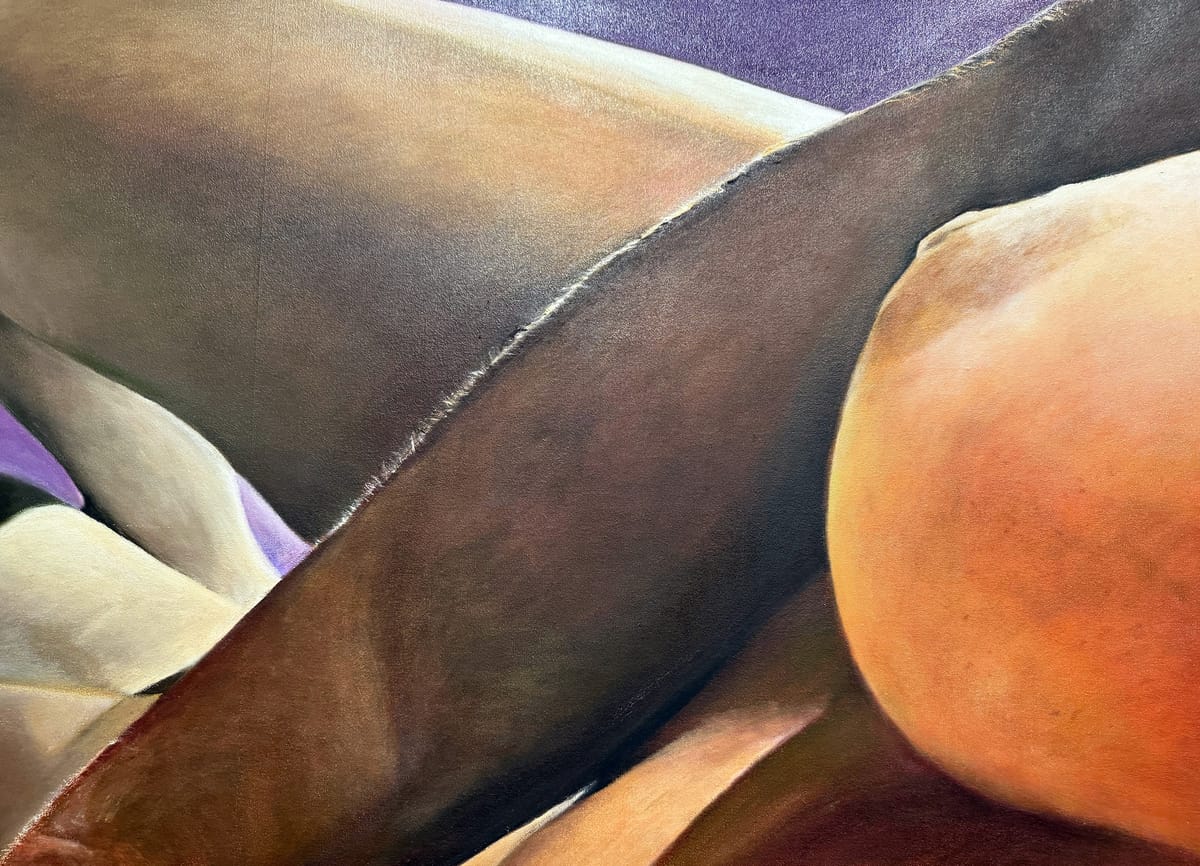
Joan Semmel’s paintings of contorted women — sometimes realist, sometimes surreal or abstracted — are mesmerizing and beautiful, but they are also disturbing. When her work is framed as such, the focus is typically shifted to the viewer: It unsettles because we’re used to media depictions of young, taut bodies, or it forces us to confront our own relationship with beauty standards and aging. I think that flattens her work. These paintings are far weirder than they get credit for.
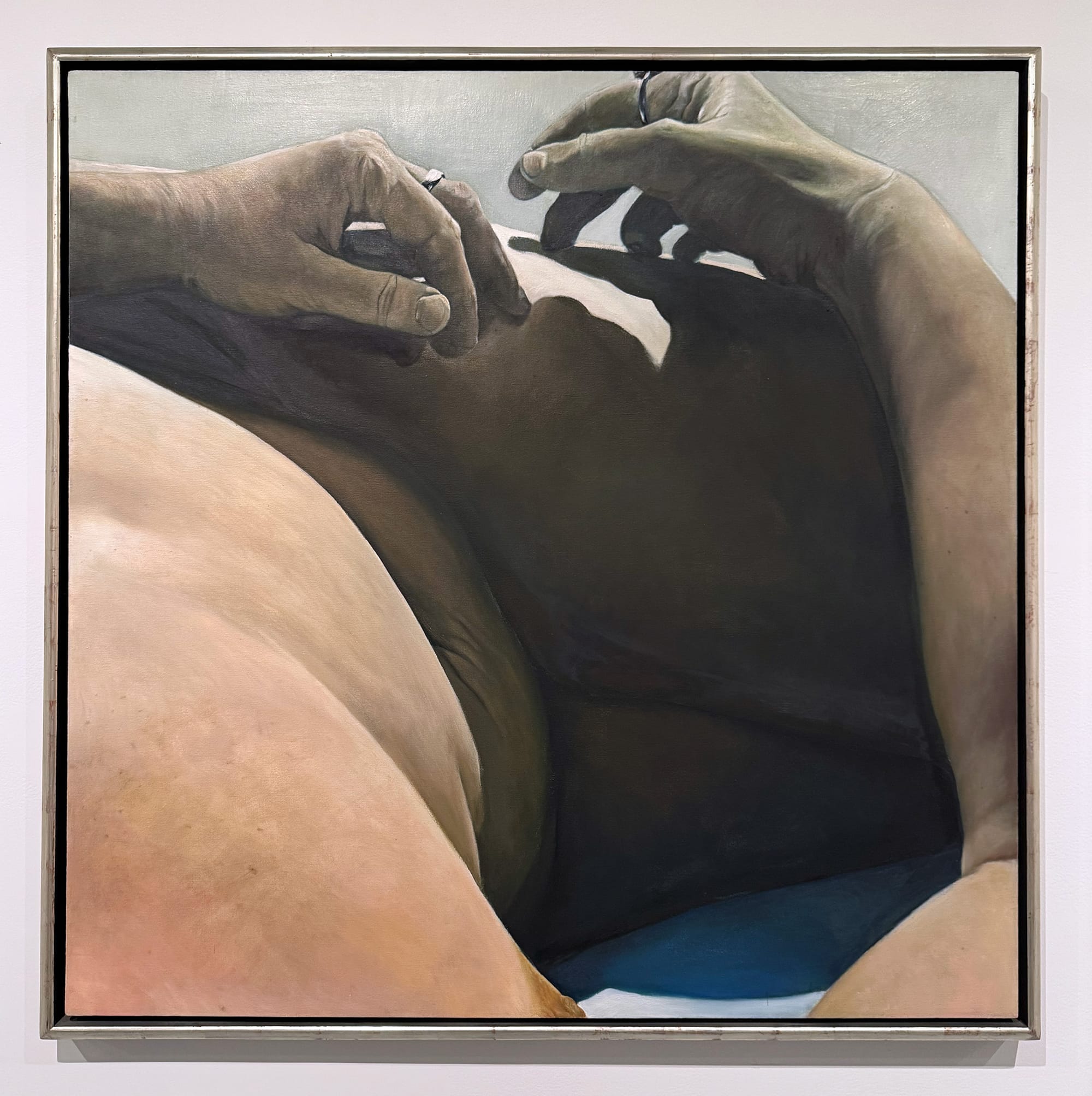
The 16 paintings in the one-room exhibition Joan Semmel: In the Flesh at the Jewish Museum constitute a sampling of various series from her half-century career, with a section in the center dedicated to works the artist selected from the museum’s collection. Toward the middle of the chronological review is “Horizon With Hands” (1976) — even its title is disquieting, suggesting a fusion of landscape and flesh. The bulk of the square painting is almost featureless; we could be looking at an expanse of stone or a rippling dune. It is the hands along the top edge that orient us: Follow an arm around the right side, and it clicks that we are the vantage point, looking down on our torso, a slab of torqued flesh — it takes a beat longer than is normal, or comfortable, to recognize a depiction of the body. Upon that realization, I felt a sense of dreamy, claustrophobic paralysis: Who am I, how did I find myself here? I wanted so badly to see a finger twitch, to feel in control of myself again within this alien form.
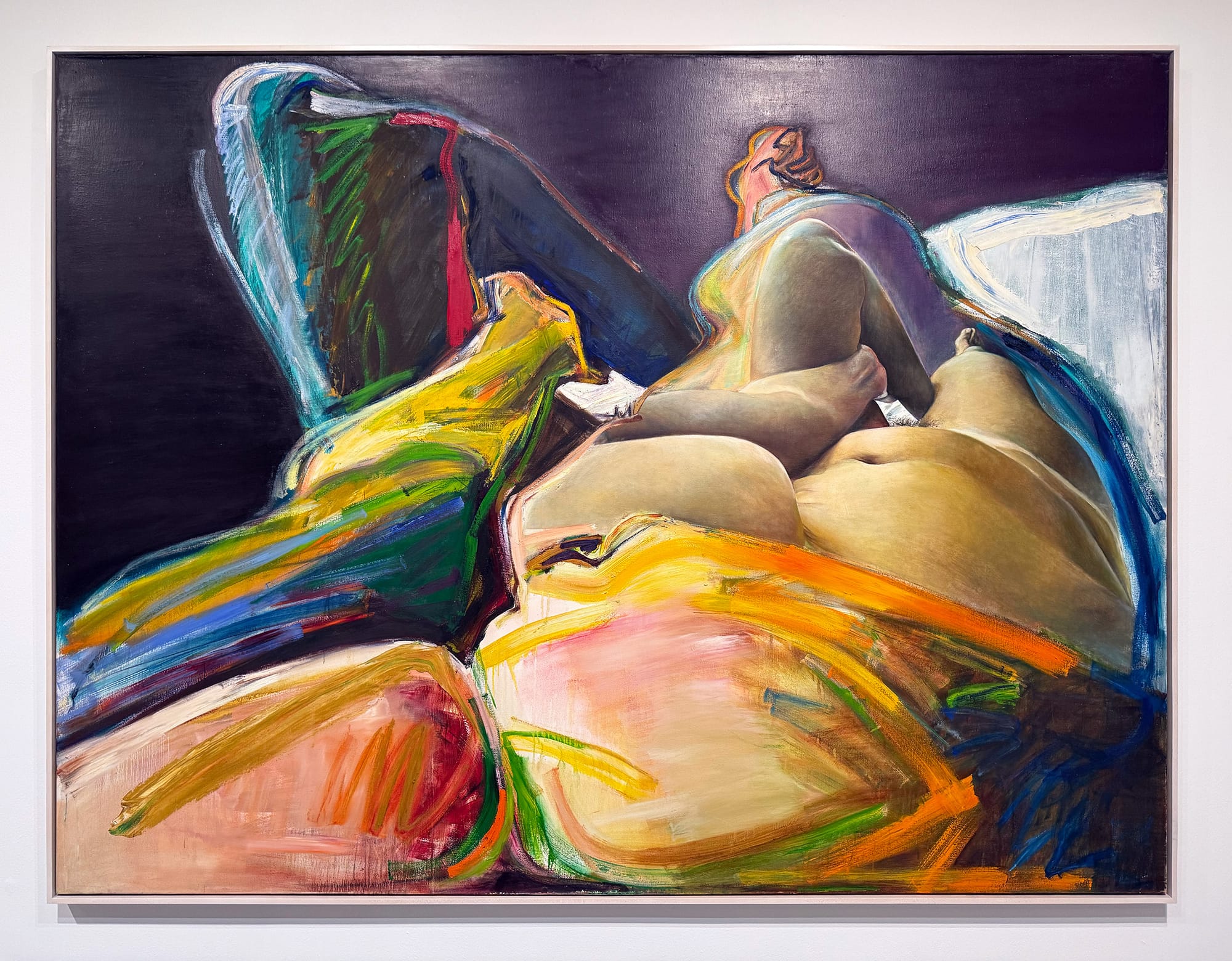
A similar destabilization results from looking upon “Purple Diagonal” (1980), whose title also suggests a figure abstracted, even obliterated. A realistic prone body, encased Escher-like in a colorful squiggly outline, offers the key: The larger composition is a doubled form of this smaller vignette, which sits embedded in the right thigh of a heavily abstracted figure. Suddenly, that heap of lurid, dashed strokes in the foreground snaps into focus as a torso — and not just any, but ours.
The uncanniness is nested, deliberate. Semmel does not just double the figure but makes it flicker between body and not-body, ours and nothing. Refusing to settle into an object, the human form remains stranger and more powerful, something that resists being held down as any one thing. For that reason, I refuse to call these paintings “erotic,” a word so often associated with Semmel’s work. Instead, they insist that women’s bodies are interesting for more than their eroticism.
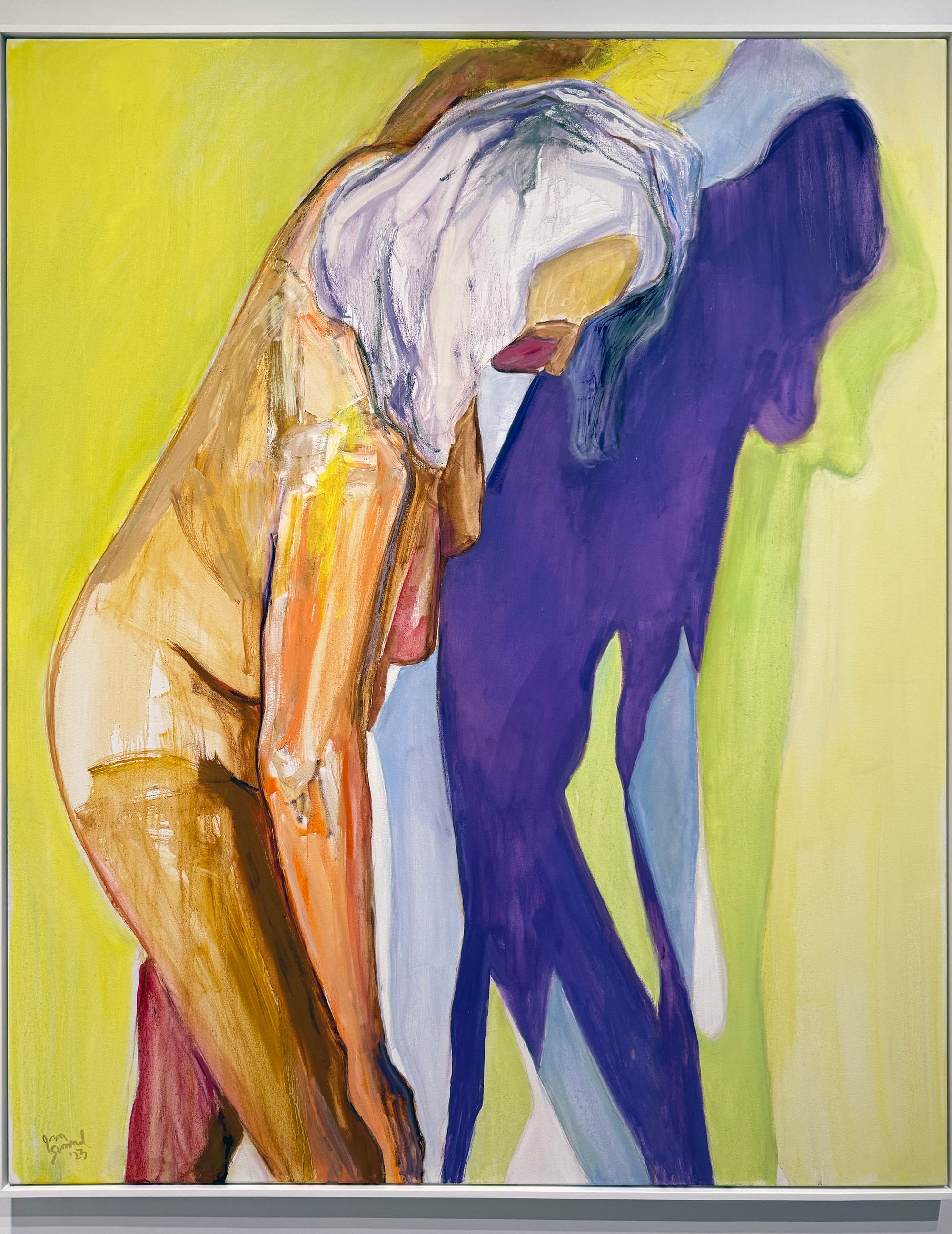
Similarly, while old and older women are certainly visually underrepresented, Semmel’s depictions go further than mere representation, which can still enact tokenization and generate indifference or even repulsion. Instead, she renders them compelling, which is more interesting and important than rendering them beautiful — the terms to which her project is so often reduced. I love the delightfully strange push-and-pull of “Parade” (2023), in which wet paint trickles downward, mirroring the physical and emotive droop of the figure, while the energetic vertical brushstrokes form the painting’s spine, holding it rigorously upright. It models a way of looking at and thinking about the aging body that expands its visibility rather than just reproducing it. Though the viewer doesn’t quite become the figure depicted in these paintings, we are drawn into a plane organized entirely by its presence. Its unsettling details — the close crop, the magenta of her barely seen face, the flurry of strokes toward the top that may or may not represent a hand — pull you into the painting's logic, forcing you to inhabit its disorienting perspective.
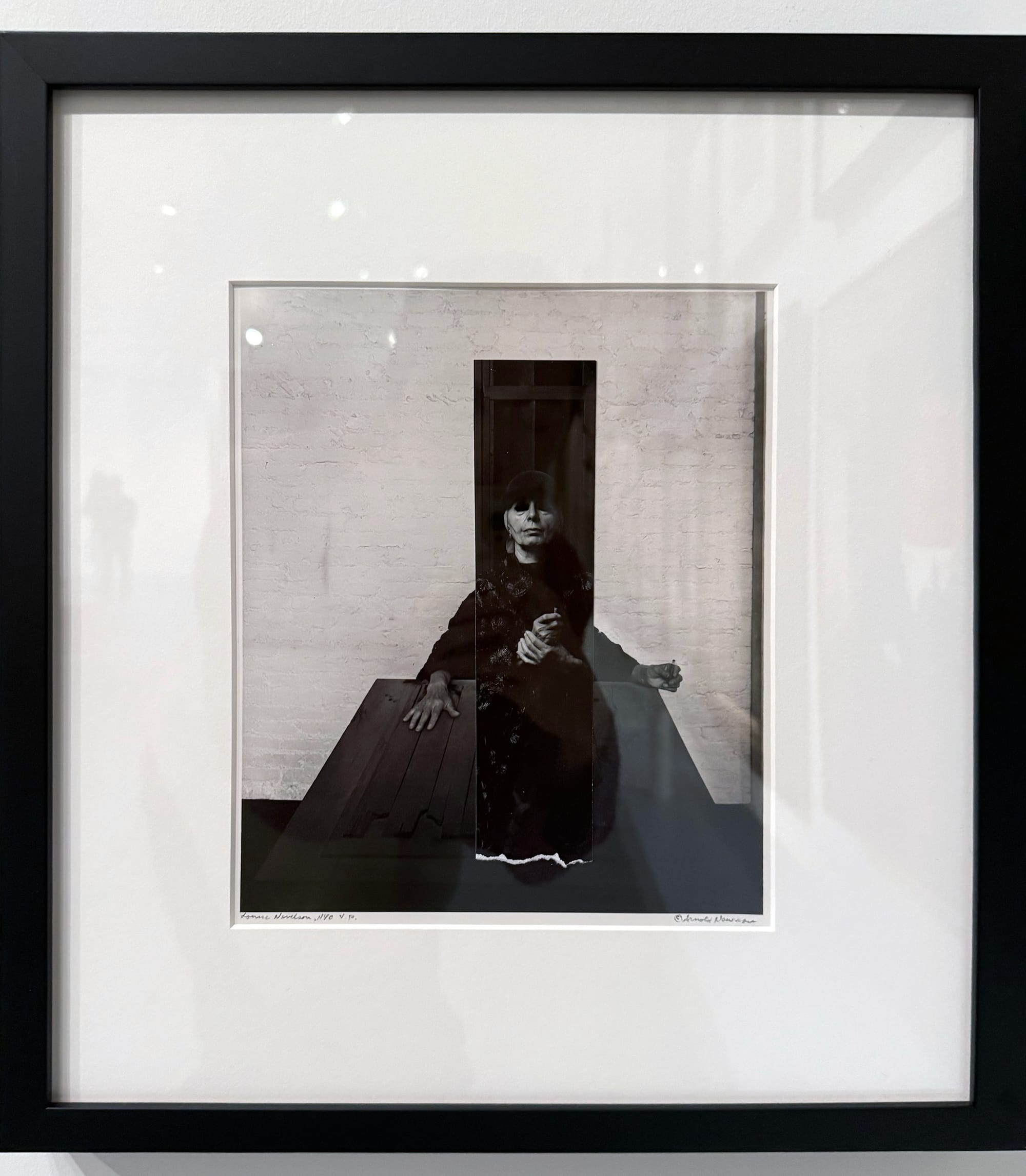
Many of the works from the collection Semmel selected for this show extend that uncanny charge, engaging with womanhood through depicting bodies in subtly strange ways — and they're not necessarily by women, underlining that representation alone isn't what's at stake here. In Arnold Newman's 1972 photograph of Louise Nevelson, a black monolith containing the artist’s visage interrupts the composition like one of her own sculptures, foregrounding those commanding hands that generated an entirely new artistic vocabulary.
Here is the body rendered strange, made into the kind of visual puzzle Nevelson explored in her work. Semmel operates from the same principle. As she often responds when asked how she feels putting herself on display: “It isn't me. It's the painting.”
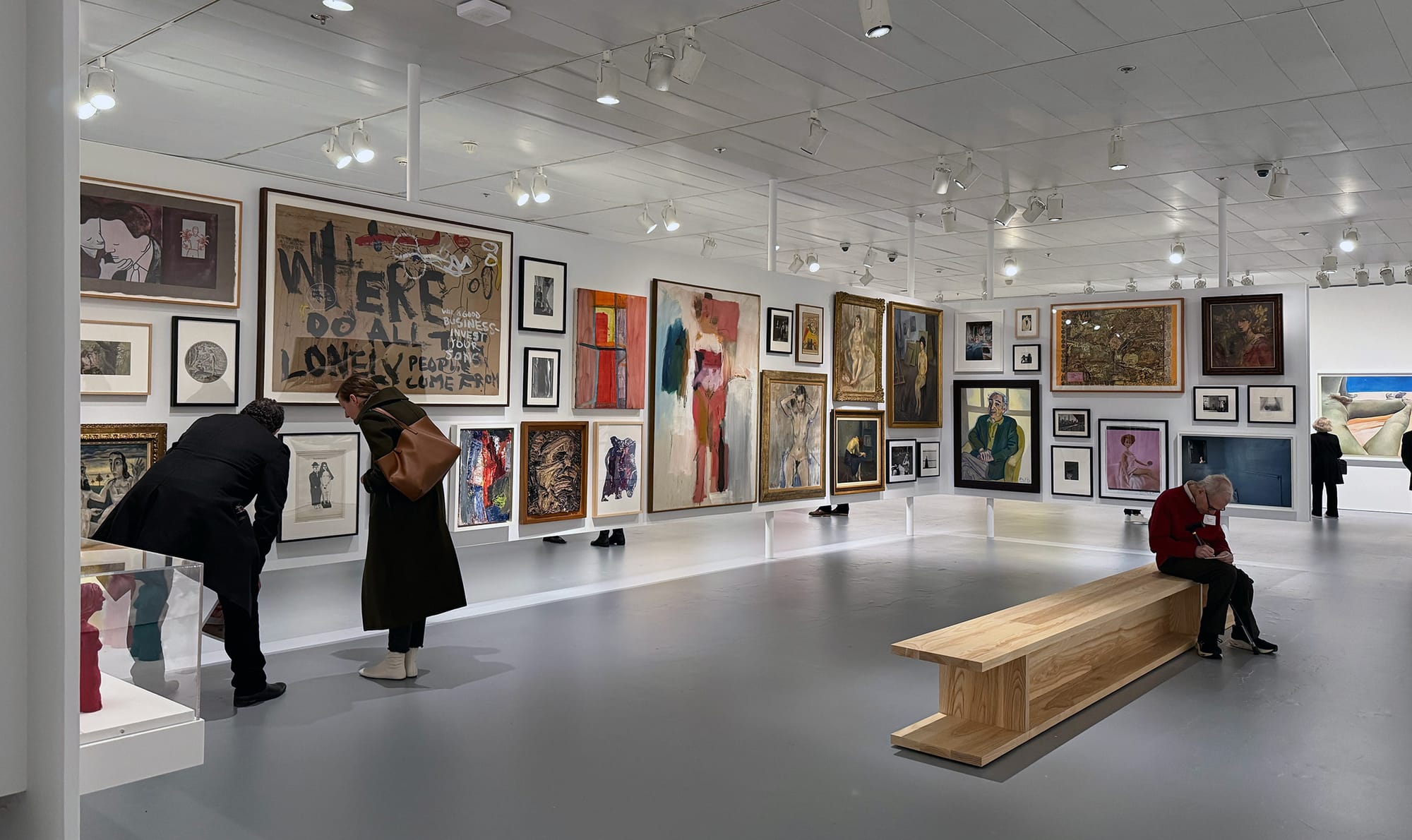
Joan Semmel: In the Flesh continues at the Jewish Museum (1109 5th Ave & East 92nd Street, Upper East Side, Manhattan) through May 31, 2026. The exhibition was curated by Rebecca Shaykin and Liz Munsell in partnership with the artist.