The Unruly Ceramic Beings of Kathy Butterly
The artist’s quasi-vessels incorporate folds, indentations, apertures, and coverts, which hint at bodily, biomorphic, and natural forms.

SARATOGA SPRINGS, N.Y. — Kathy Butterly’s marvelous retrospective Kathy Butterly: Assume Yes spans 32 years of small-scale ceramic sculptures — and “small-scale” puts it mildly. The first work in the exhibition, “Eddy’s Skirt” (1994), around eight inches tall and three inches wide and deep, is a mesmerizing treasure. It has also rarely been seen by the public since its gallery debut decades ago.
“Eddy’s Skirt” is a mostly beige jar- or urn-like object with pink and white stripes curving down its surface, suggestive of a skirt — one of many evocations of female apparel and adornment in her work — set atop an hourglass base. It is a decidedly idiosyncratic version of a utilitarian ceramic vessel, but also hints at the curves and contours of the human, particularly female, body, with suggestions of a midriff, neck, and head, one example of the merging of humans and non-human in Butterly’s work. Nesting in interlacing beige strands at the top — a bit like wickerwork or a rib cage seeded with slight, red splotches — is a cluster of tiny balls, each meticulously handcrafted: seeds in a pod, eggs, pearls, maybe even ideas in a brain. Abstract markings adorn the “skirt.”
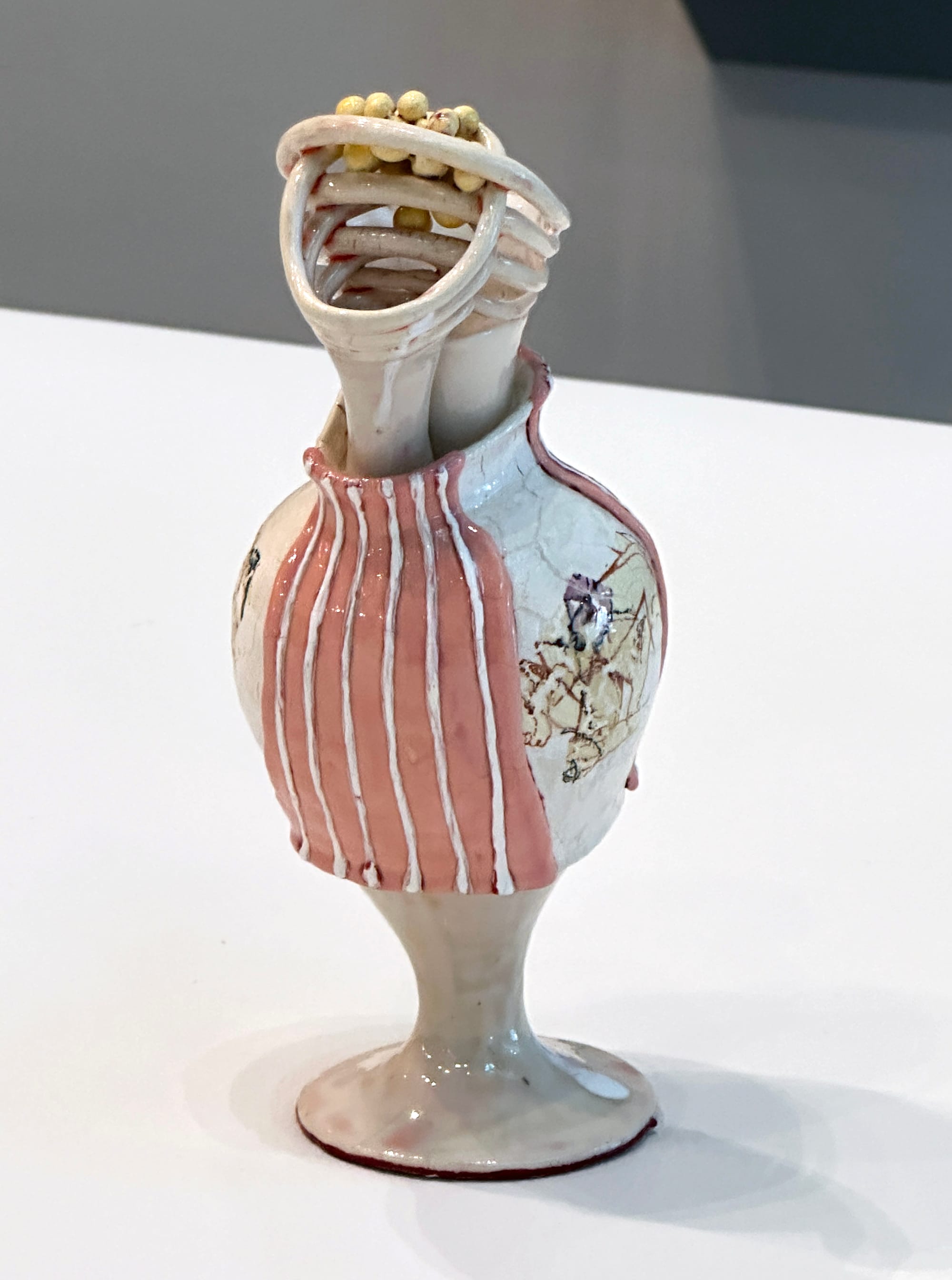
This hybrid vessel/figure is close to the bone. It leans forward, expectantly, as if about to take center stage, but also seems hesitant, even vulnerable — an admixture of avidity and trepidation. Butterly has a remarkable way of channeling nuanced spirit, keen emotions, and complex psychological states into her innovative and riveting creations, a defining feature of her entire body of work.
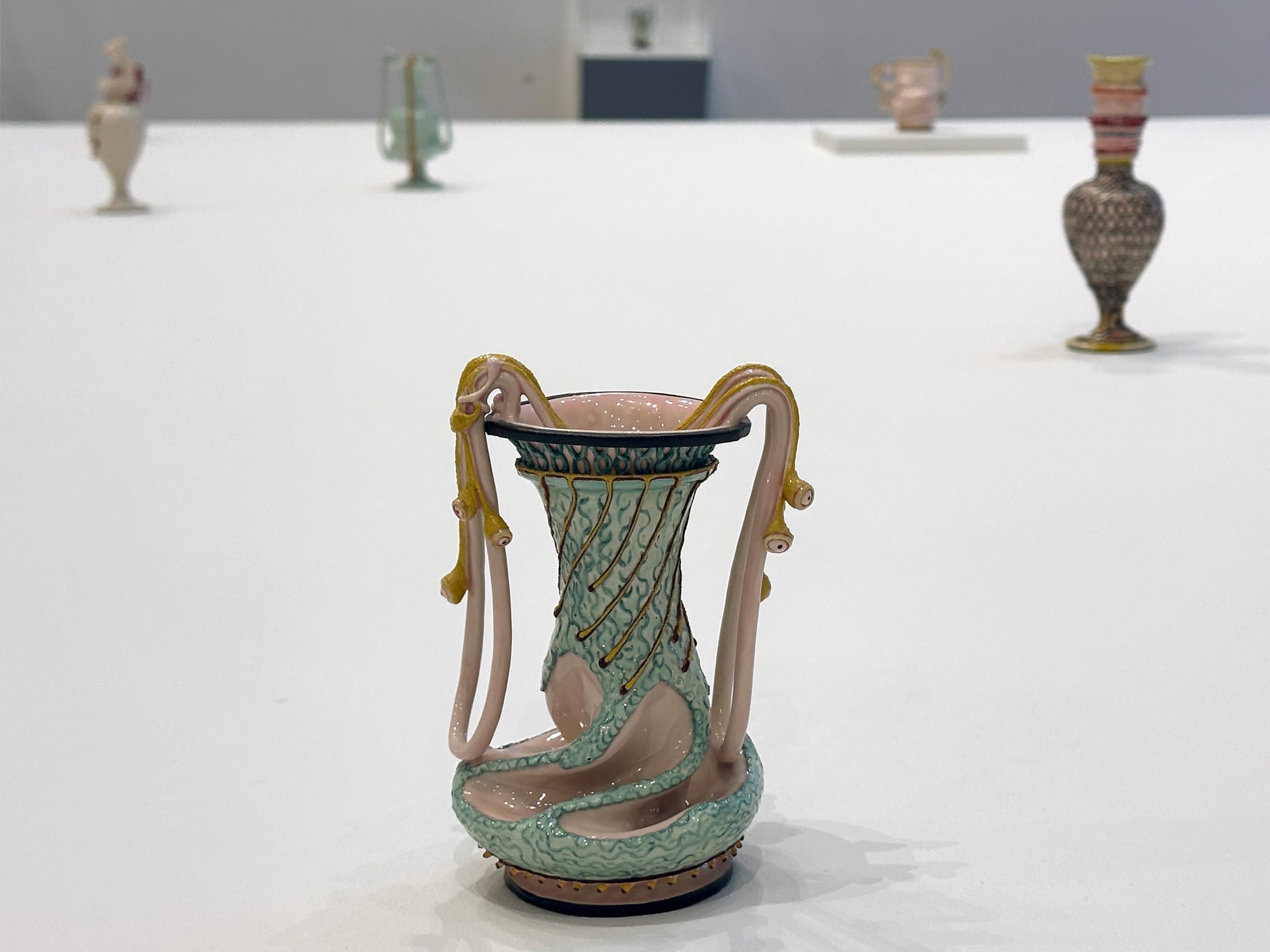
Wonders abound throughout the exhibition — each sculpture both a beckoning event and a voyage. Butterly’s quasi-vessels incorporate folds, indentations, apertures, and coverts, which hint at bodily, biomorphic, and natural forms, including geological structures and such world-shaping processes as gravity, sedimentation, erosion, eruptions, and landslides. They also connect with various art-making procedures, like pours, drips, and spills.
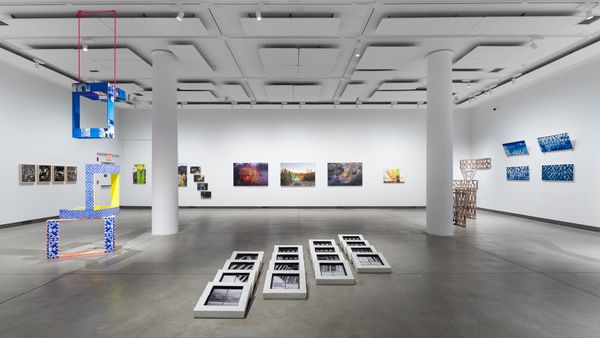
The show features 45 glazed porcelain and earthenware sculptures, except for one that includes enamel paint, arrayed on three trapezoidal platforms and installed on walls. All were created through hands-on sculpting, multiple firings, multiple glazes, rich and varied coloration, and the use of eclectic implements, including dental tools. The three groupings correspond to successive periods: early works from the 1990s until 2001, notable for the fact that Butterly was working on a diminutive scale in an out-of-favor medium often relegated to crafts subjected to gender biases; those from 2003 until 2019; and more recent works. Together, they form a fascinating and immersive community of sorts, not just ceramic sculptures but lively, varied, evocative, and intensely communicative sculptural beings.

Some are joyful and exuberant, suggesting pageants, performances, and parades. “Wave ‘Em Like You Just Don’t Care” (2001) features a beige, fleshy, loosely cylindrical form with a middle that looks downright intestinal, suggesting a human figure. Springing from its top on curving stalks are two reddish, intricately detailed balls, a bit like pompons, brains, or eyes. This gloriously eccentric sculpture seems to be moving in several directions simultaneously, as if in an ecstatic dance.
“Mask” (2003) is melt-your-heart wonderful. A yellow-gold, loosely bird-like form with a torso resembling the hollows and ridges of a human ear, eyeless with a tiny beak/nose, it seems hopeful, tender, fragile, and alert as if in anticipation or yearning. I am reminded of Emily Dickinson’s great 1861 poem conflating hope and a bird (“Hope is the thing with feathers -/ that perches in the soul”). The top part of “Mushroom Nirvana” (2011) — a wild variation on and transformation of a two-handled vessel — is a luxurious and eye-popping deep blue, to my mind Yves Klein blue; it feels entropic, as if cracking apart. Beneath two awkward, precarious, and irregular handles is a riot of bulging orange and yellow forms and a black and yellow speckled base. It is a wonderful example of how Butterly seeds her exquisite sculptures with jarring notes and willful disturbance. She deals in both unruliness and grace.

Other works are hardly joyful. I am struck by how sculptures made years ago — born, I’m surmising, from Butterly’s engagement with a turbulent world — are spot on right now. See, for instance, “Heavy Head (Toro)” (2003–4), a bulbous, yellowish sculpture with thin crimson stripes. Its gourd- or head-like form seemingly topples from a tiny red bench — a sculpture collapsing under its own weight, intimating a person weighed down by worry and care. Made during the Iraq War, many years later, this work feels like it encapsulates the heaviness, despair, anger, and frustration that so many of us are experiencing when confronted by a new war of choice with Iran, atrocities in Gaza and Ukraine, the grotesque horrors of ICE, and the daily, seemingly hourly anti-democracy outrages coming from President Trump and his MAGA cheerleaders in the government.
The first two groupings are more elaborate, multipart, and maximal, particularly for sculptures so small, with a multiplicity of forms and disparate, vivid colors. Here, Butterly lavishes attention on little things — including on areas that one hardly notices at first, or even at all. Only when you peek into the opening at the top of “Line Dance” (2012) will you see vibrant red drips and pools, cartilage-like ridges, and various orifices. Throughout, there are secrets in nooks, surprises in crannies. Butterly’s works welcome and reward patient, sensitive viewing.

This exhibition highlights how crucial a painterly sensibility and a deeply felt absorption with color are in her work. In a walk-through at the museum, Butterly mentioned a particular red in New York graffiti that stunned her, the hues of Maine flowers that enraptured her. She channels such lived experiences into her sculptures.
Works in the third section of the most recent works involve something relatively new for Butterly. The base of each is a meticulously rendered cube. Rich colors (often monochromatic or near-monochromatic) enliven and animate these geometric, ultra-rational, Euclidean forms, which both support and are in dialogue with the freeform, multicolored parts above. The top parts are transformations of a basic bowl shape. Curved vessels with circular openings have morphed into remarkable new shapes and identities, which thoroughly blend abstraction and figuration. With its seething and bubbling orange, black, and white coloration, “Nightside Out” (2025) seems positively molten. The whiteish (delicately tinged with yellow) “Assume Yes” (2022) attests to the larger horizons Butterly is beginning to gesture toward. It is wondrously cosmic and ethereal — an ultra-condensed version of a vast, interstellar cloud.

Kathy Butterly: Assume Yes continues at the Tang Teaching Museum & Art Gallery (815 North Broadway, Saratoga Springs, New York) through July 26. The exhibition was curated by Ian Berry.