National Pavilions We Loved at the Venice Biennale
As the punishing heat waves of this summer taper off, this might be the perfect time to visit the international exhibition.


You've followed our on-the-ground reporting from the consequential 2026 Venice Biennale, running through November 22. You've read, I hope, our reviews of Koyo Kouoh's posthumous main exhibition In Minor Keys, Alma Allen's unmemorable United States pavilion, and Gabrielle Goliath's Elegy — displayed at a church after being cancelled by the South African pavilion. You’ve engaged with our coverage of Dayanita Singh's project at the State Archives of Venice; Arthur Jafa and Richard Prince's hit-and-miss collaboration; an interview with Khaled Sabsabi, whose Australian pavilion was censored under pressure from pro-Israel groups and later reinstated; and much more from the international exhibition and its collateral events.
But we never got to tell you what we really thought of the national pavilions, and which ones you should visit or avoid. As the punishing heat waves of this summer taper off, this might be the perfect time to visit the biennale, if you haven’t already. Below is the first part of a conversation between Editor-at-Large Hrag Vartanian and critic Aruna D'Souza on which pavilions they liked, disliked, or remain torn about. They begin with a provocative argument in favor of national pavilions. Did they suddenly become nation-state stans? No, hold on, hear them out.
—Hakim Bishara, editor-in-chief
Prologue: In Defense of National Pavilions
Hrag Vartanian: I know it’s a popular trend to decry the national pavilion concept, and past biennials have jettisoned the idea altogether, such as the São Paulo Biennial. But I think what makes Venice important and central is the tension between the main exhibition and the national pavilions. You can decry them all you want, and we should, since the nation-state has a great deal of issues, but our national identities and passports determine everything from funding to media attention.
Removing them may make a bunch of academics and curators feel better for appearing above the fray, but all it would do is mask their privilege and fail to grapple with the fact that national borders still dictate so much. Look no further than the Venice Biennale’s own overrepresentation of Nordic countries, fossil fuel-funded monarchies and autocratic states, and other wealthy nations that funnel money to the arts, whether through government or private means.
National pavilions also allot an opportunity for smaller nations to center their own artistic conversation. Discarding them would likely result in countries like Timor-Leste, Cape Verde, Nauru, and other nations practically disappearing in the larger exhibition, which happens at other biennials. The idea of removing national pavilions is usually most popular in the most privileged circles, often among those with the strongest passports, which tells you all you need to know. This year’s boycotts underlined the pressure points, and while I think some of the intervention was uneven — for instance, I’m not sure why ANGA didn’t highlight Turkey’s role in aiding Israel’s genocide in Gaza, despite the fact that the government has been central to access to gas and other resources, while underscoring the role of every other country with a pavilion in the Arsenale and Giardini — it was still valuable.
Aruna D'Souza: I agree with this sentiment in general, especially given how many countries were able to show for the first time. Thirteen pavilions from countries in Africa! Panama had a pavilion at a time when Trump is threatening their sovereignty! And there are many more examples besides.
The only downside of the way national pavilions are conceived, to my mind, comes when you look at the introductions to these displays. For so many of them, the commissioner or sponsor is listed, then the curator, then the exhibitor, aka the artist. This is how the Biennale itself wants things listed, if their catalog of national participation is any indication. I hate this demotion of the artist to a mere bureaucrat in service of a country so very much.
Ecuador
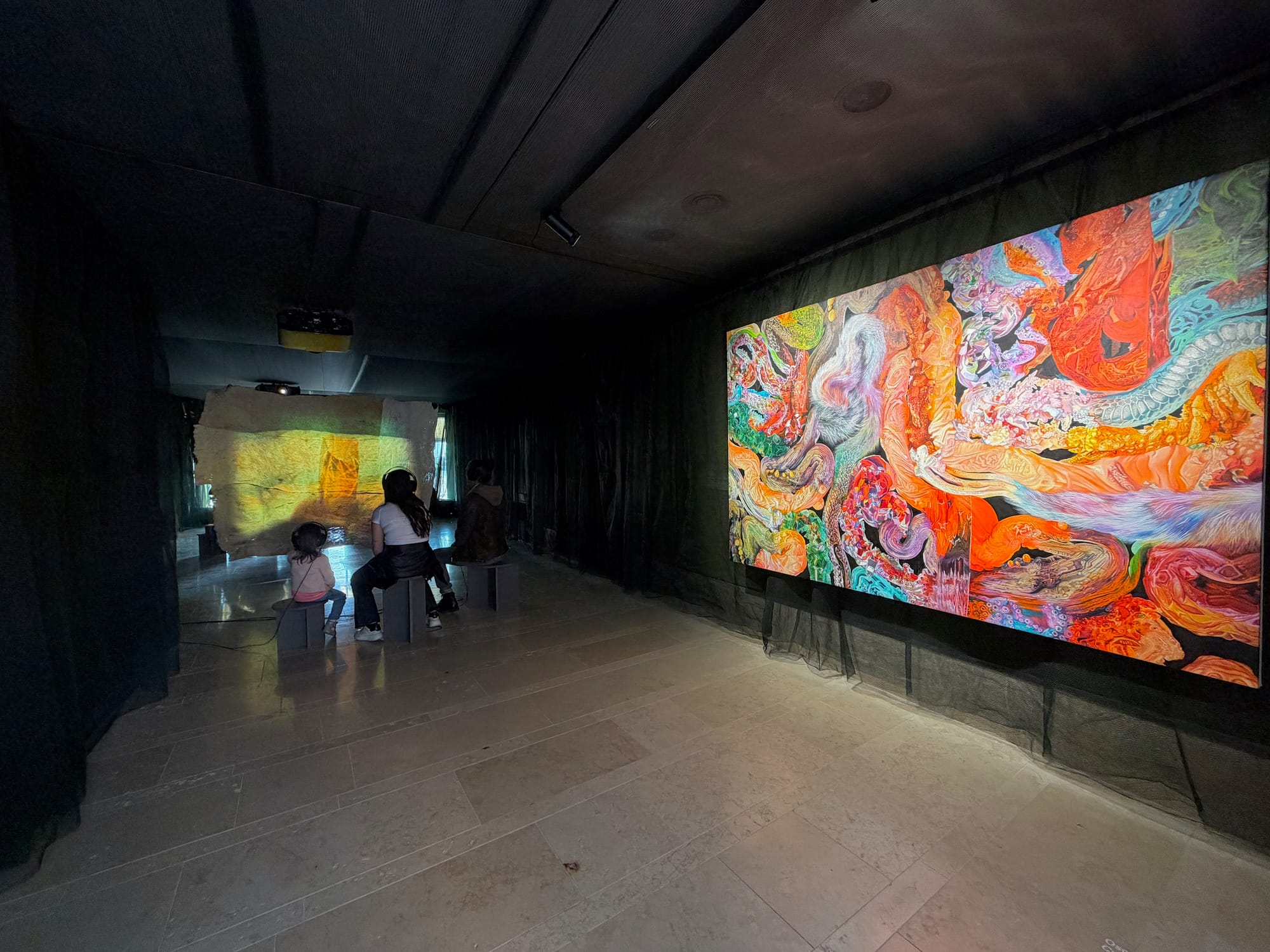
Balancing the Indigenous-led Tawna collective and artist Óscar Santillán, the Ecuadorian pavilion was an oasis of storytelling and reflection. The 26-minute video “Llaki” (2025) by Tawna was a particularly poignant story of how Indigenous people of non-heteronormative sexualities are forced to endure colonial structures, and how those same mores infect and change families and relationships. It doesn’t focus on the sadness of loss, but rather uplifts us by demonstrating how resilient those identities can be. Santillán’s “Medula” (2026) was a curious assemblage that included, according to the label, “Alien DNA,” while a neighboring work used a circuit board. It demonstrated the same resilience and fearless confrontation of the world and its ills. —HV
Democratic Republic of Congo
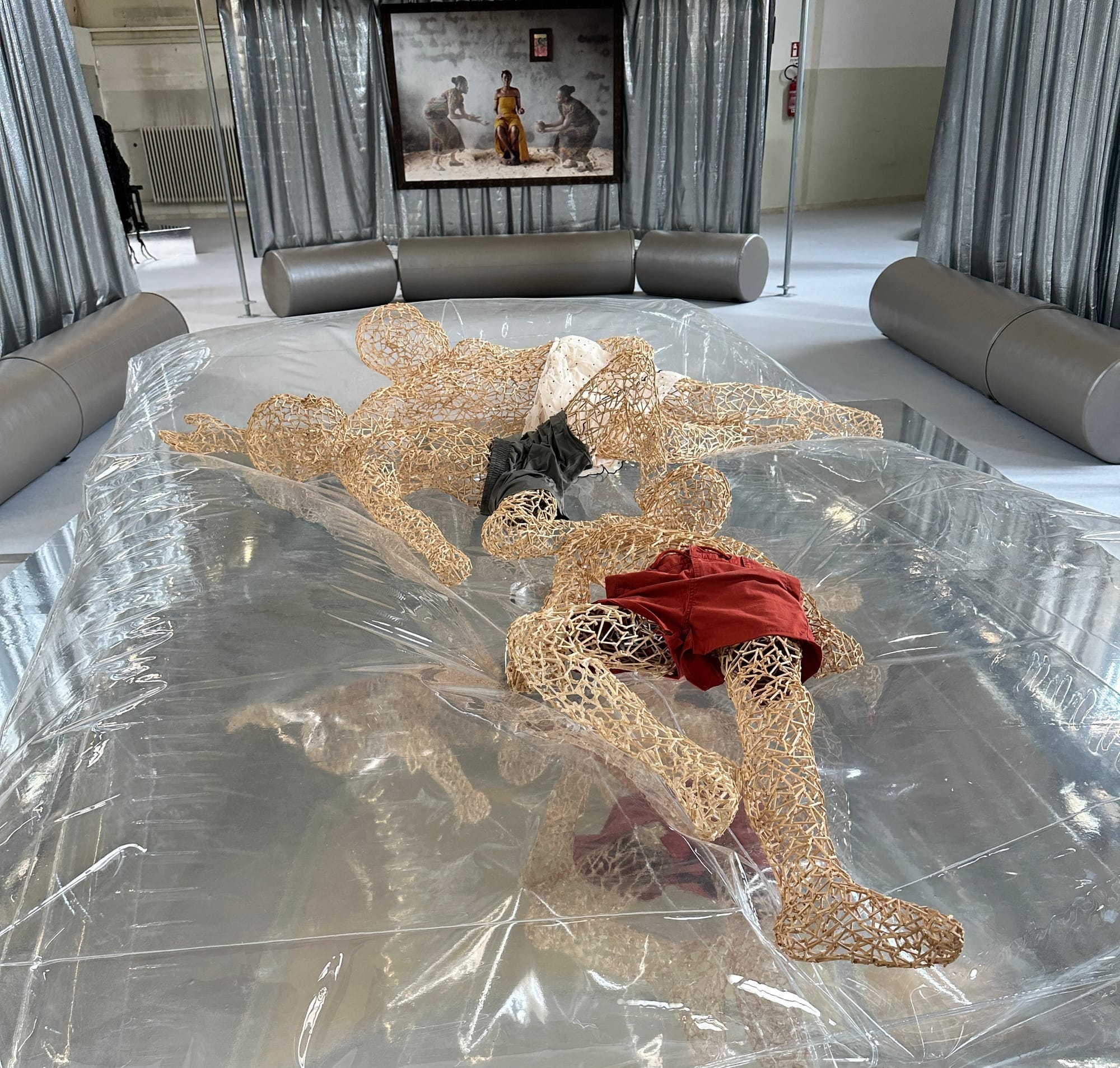
Nine artists from the DRC and its diaspora brought the heat for the country’s inaugural participation in the biennale, under the trilingual title “Simba Moto! Seize the Fire! Saisis le Feu!” At the center of an installation designed by Johnny Leye, principal in the architectural firm Traumnovelle, an oval structure with plenty of places to sit a while and contemplate the art, we find Aimé Mpané’s “Le Souffle” (2026), in which three figures — a mother and two sons, made out of match sticks so they seem like topographically defined shells — sprawl on an air mattress. They could be comfortably napping in their beds, but they could also be drifting on an inflatable raft, searching for newer, safer homes. The photojournalist and documentary photographer Arlette Bashizi captures scenes from the eastern part of the country, including those of environmentally devastating mining practices. Patrick Bongo’s sculptures, made from recycled rubber, deepen the reflection on the human and environmental costs of dirty industries. Sammy Baloji’s tapestry, “Seeing Katharina” (2026), delves into the colonial histories that brought us to this point. In all, the show is ambitious and fierce. —AD