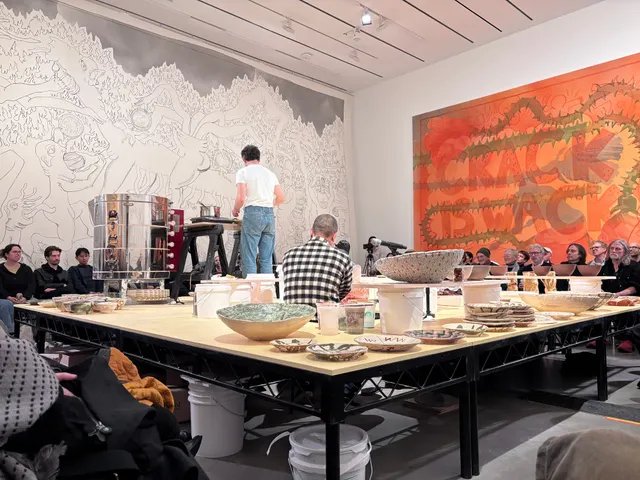
At the center of Matthew Lutz-Kinoy’s The Mud Room, a raised platform containing a large kiln, two ceramicists’ alcoves, and buckets of clay acts as a stage. The first play explores the intersections of farming, the kiln, and the emergence of the artspeak-adjacent locavore chef.
While Amant’s on-site restaurant served its own fare of purple radicchio and Block Island anchovies to the audience, seated in a perimeter around the action, the protagonist, Marin — a failed curator turned restaurateur in rural France — droned on about her hopes for a publisher to appreciate her culinary foray as a radical “linguistic concept” and “rhizomatic” project.
Meanwhile, four paintings surrounding the stage ridicule the posturing of the art-world types in the first performance. Directly opposite the entrance, monstrous figures swallow one another’s entrails and phallic appendages while exchanging the fruits of their labor: ceramics. To the right, Lutz-Kinoy’s “The Rose Garden” (2026) combines an homage to Keith Haring’s “Crack Is Wack” (1986) with silhouettes reminiscent of Aaron Douglas’s New Deal-era public commissions. Opposite it, another painting pays tribute to Douglas, as well as to Philip Guston and Reuben Kadish’s restored “The Struggle Against War and Fascism” (1934–35).